
The Bandhgala Jodhpuri Suit: A Complete Guide to India’s Most Commanding Ethnic Silhouette
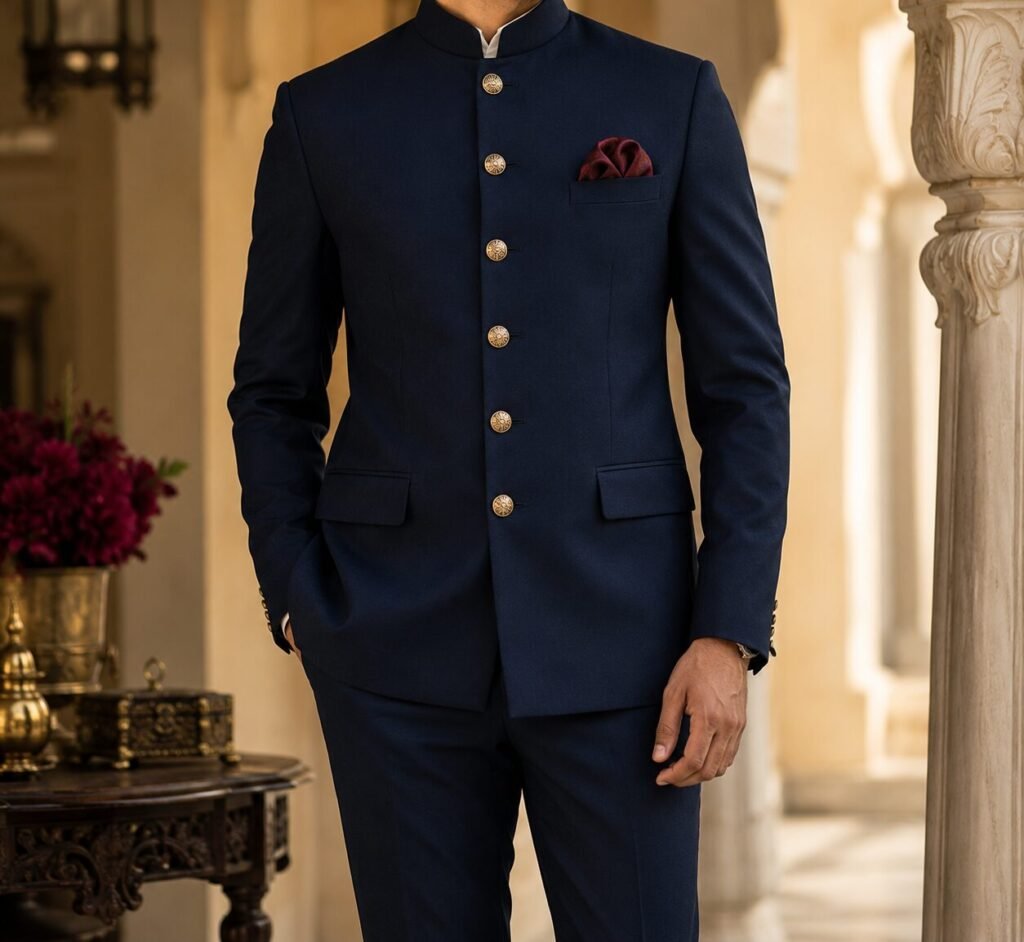
A bandhgala jodhpuri suit is a complete two-piece Indian formal ensemble comprising a structured, lapel-free coat with a closed stand collar (the bandhgala) and a pair of matching tailored trousers – together forming what is widely regarded as India’s most authoritative ethnic silhouette for men. It is worn at weddings, formal receptions, diplomatic engagements, and high-ceremony festive occasions. The key distinction from a plain bandhgala jacket is the matching trouser set: the jodhpuri element transforms a standalone jacket into a coordinated suit of equal formality to a Western black-tie ensemble. In bespoke form, it is constructed with a floating canvas chest, hand-sewn buttonholes, and a precisely rolled collar – details that separate a garment of genuine craft from a mass-produced approximation. The Bandhgala Jodhpuri Suit: A Complete Guide to India’s Most Commanding Ethnic Silhouette Few garments in the canon of men’s formal dress carry the structural authority of the bandhgala jodhpuri suit. Rooted in the princely courts of Rajasthan, refined through a century of tailoring evolution, and now worn at the highest levels of Indian ceremony and diplomacy, it occupies a position in Indian menswear that has no direct Western equivalent. It is neither a suit in the European sense nor a traditional sherwani – it is something more precise: a garment that communicates cultural identity through disciplined construction rather than decorative excess. This guide covers every dimension of the bandhgala jodhpuri suit – its history, anatomy, fabric options, fit requirements, occasion styling, current design directions, and long-term care – written from the perspective of practitioners who cut and construct these garments by hand. What Is a Bandhgala Jodhpuri Suit? A bandhgala jodhpuri suit is a structured two-piece Indian formal suit consisting of a closed-collar coat – the bandhgala – paired with matching tailored trousers cut from the same cloth. The term combines two distinct garment identifiers: bandhgala (from Hindi, meaning “closed neck”) refers to the stand collar that fastens at the throat without lapels, and jodhpuri denotes the complete suit format – coat and trouser – that originated in the royal court of Jodhpur in Rajasthan. The distinction between a bandhgala jacket and a bandhgala jodhpuri suit is precise and meaningful. A bandhgala jacket is a standalone upper garment, typically worn over churidars, trousers, or kurta-pyjama. A bandhgala jodhpuri suit is a coordinated two-piece ensemble in which the coat and trouser are cut from identical fabric, creating a unified formal silhouette of the highest ceremonial register. Comparison: Bandhgala Jacket vs Bandhgala Jodhpuri Suit Feature Bandhgala Jacket Bandhgala Jodhpuri Suit Garment components Jacket only Structured coat + matching trousers Collar style Closed stand collar Closed stand collar Occasions Semi-formal to formal; festive Formal to black-tie; weddings; diplomatic Formality level High Very high – equivalent to Western black tie Styling flexibility Worn over churidars, trousers, kurta Worn as a complete coordinated set Fabric coordination Jacket fabric independent of trouser Coat and trouser cut from identical cloth Construction standard Varies; often lighter Typically full-canvas or half-canvas The jodhpuri suit for men thus represents the most formal expression of the bandhgala silhouette – a complete garment system rather than a separates-based ensemble. The History and Royal Origins of the Jodhpuri Suit The bandhgala jodhpuri suit did not emerge from a single moment of invention. Its lineage runs from the fitted, high-collared court garments of the Mughal era – the jama and angrakha of the 16th century – through the military dress of Rajput nobility, and into the tailoring workshops of late 19th-century Jodhpur, where Indian court tradition met British suiting conventions. The Mughal courts under Akbar formalized a culture of structured, close-fitting court dress with high-standing collars and precise front closures. These garments, worn by nobles and military commanders, established the aesthetic vocabulary that would later define the bandhgala: authority expressed through restraint, the collar as a mark of rank. As documented by historians of Indian dress – and traced in detail in Indian Railways, Bandhgala Uniforms, the Mughal Origins – the closed-neck silhouette was already a signifier of formal power long before it encountered European tailoring. The Jodhpuri suit connection crystallised in the late 19th century. The Jodhpur royal family, renowned for their horsemanship and military bearing, adapted the fitted court jacket for riding and polo – practical garments that required structured shoulders, a suppressed waist, and freedom of movement. The matching trouser, cut with a slight flare at the thigh for equestrian use, became the precursor to what we now call the jodhpuri trouser. The ensemble’s association with Maharaja Pratap Singh of Jodhpur – who is said to have had a version of the garment tailored during his attendance at Queen Victoria’s Diamond Jubilee celebrations in 1897 – helped introduce the silhouette to an international audience familiar with Savile Row conventions. The result was a garment that synthesised two great tailoring traditions: the structural precision of British suiting and the cultural authority of Indian court dress. The bandhgala collar – closed, standing, fastened at the throat – became the defining element that distinguished this hybrid form from both a Western suit and a traditional Indian coat. Through the 20th century, the bandhgala jodhpuri suit evolved from royal court dress into the formal uniform of Indian statesmen, diplomats, and cultural figures. Jawaharlal Nehru’s adoption of the bandhgala jacket as his signature garment brought the closed-collar silhouette into the vocabulary of modern Indian public life. The jodhpuri suit format – the complete two-piece – retained its association with the highest ceremonial occasions: weddings, state functions, and formal receptions. At Shubham Shinde Atelier, the craft lineage that informs every bandhgala jodhpuri suit we construct draws directly from this history. The closed collar is not decorative – it is structural, requiring precise grain alignment and internal support to hold its form across a full day of wear. Understanding where the garment came from is inseparable from understanding how it must be built. Anatomy of a Bandhgala Jodhpuri Suit – What to Look For A bandhgala jodhpuri suit is a garment of considerable technical complexity.
