
Bandhgala Suit for Groom: The Complete Wedding Style Guide
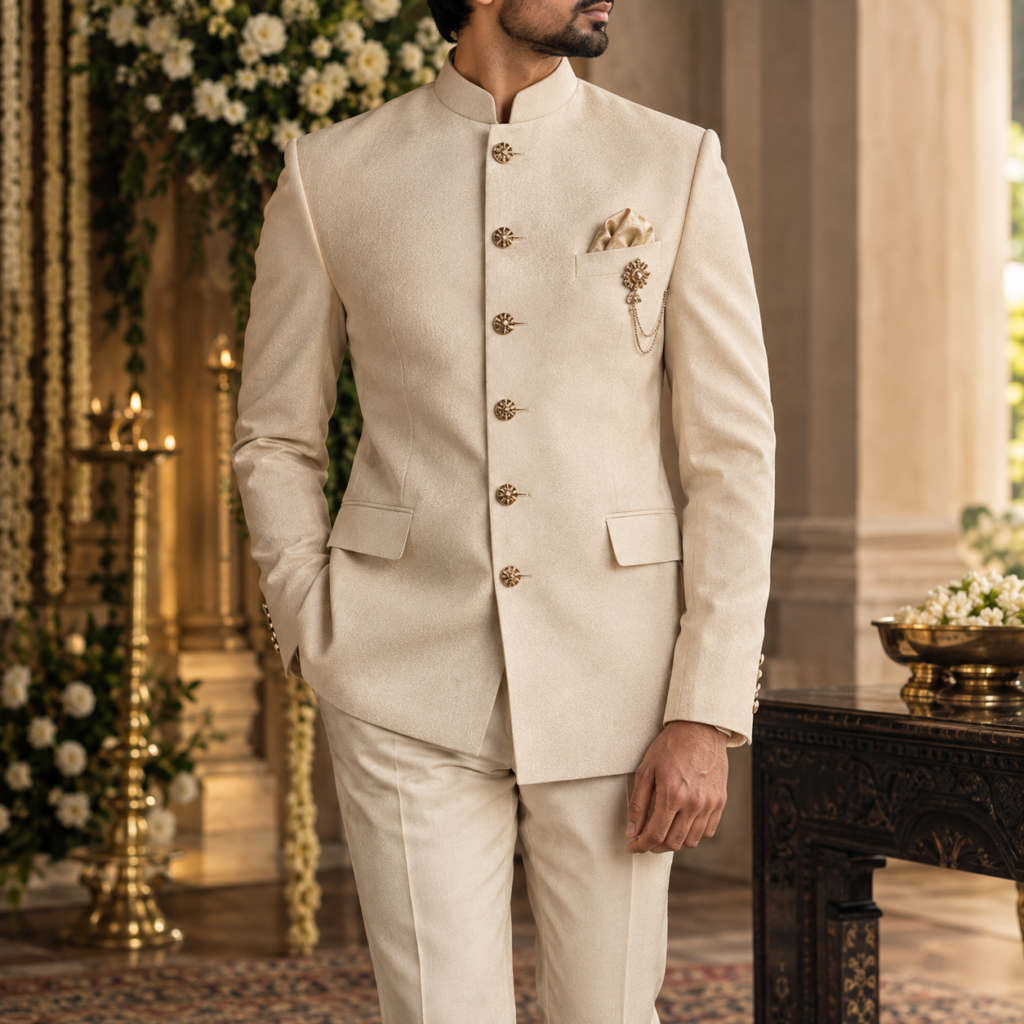
Key Takeaways Why the Bandhgala Is the Groom’s Best Weapon The bandhgala suit for groom is not simply an ethnic alternative to the sherwani. It is a garment with its own authority – structured, precise, and rooted in over four centuries of Indian tailoring tradition. Its origins trace to the Mughal courts of the 16th century, refined through Rajput warrior dress in the royal courts of Jodhpur, and eventually shaped into the closed-collar jacket recognised globally today. As Wikipedia’s entry on the Jodhpuri suit notes, the garment evolved from the Mughal jama and angrakha, absorbing Rajput warrior aesthetics before being refined into a waist-length fitted jacket worn by the Jodhpur royal family. What distinguishes the bandhgala from every other option in the groom’s wardrobe is the standing collar – the bandhgala itself, meaning “closed neck.” That collar does something no open-lapel garment can replicate: it frames the face, elongates the neck, and projects an unmistakable authority. On a wedding stage, under mandap lighting or against a reception backdrop, the silhouette reads as complete. There is nothing left open, nothing casual, nothing unresolved. Against the sherwani, the bandhgala holds a structural advantage. The sherwani is ceremonially rich but architecturally loose – its length and embroidery carry the visual weight. The bandhgala, by contrast, earns its presence through tailoring precision: the chest, the collar, the trouser break, the button alignment. A well-built bandhgala suit wedding look is as much about construction as it is about cloth. The versatility is equally important. A bandhgala jodhpuri suit for groom moves across ceremonies with minimal adjustment – a pocket square swap, a different footwear choice, the addition or removal of a safa. The sherwani rarely crosses that boundary. Bandhgala vs. Sherwani: Which One Is Right for Your Wedding? The choice between a bandhgala and a sherwani is not a matter of one being superior – it is a matter of ceremony, body type, and the formality register the groom wishes to occupy. Factor Bandhgala Sherwani Best ceremony Reception, baraat, sangeet, pheras (modern) Pheras, traditional baraat Formality level Formal to semi-formal Most formal Silhouette Structured, waist-length, tailored bandhgala pairs cleanly with red, gold, or ivory bridal wear. Maroon works alongside gold and champagne. Ivory suits almost every bridal palette. For summer weddings, lighter tones – ivory, champagne, blush – are both practical and photogenic. For winter evening receptions, deep jewel tones – maroon, navy, emerald – absorb and reflect light in a way that lighter shades cannot. Fabric Selection for a Groom’s Bandhgala Fabric choice determines three things simultaneously: how the suit drapes, how comfortable it is across a long ceremony day, and how it photographs. A bandhgala for groom built in the wrong fabric for the climate will compromise all three. Fabric Climate Ceremony Type Key Quality Pure Silk Winter, Monsoon Pheras, evening reception Lustrous, holds structure, photographs richly Velvet Winter Evening reception, indoor banquet Maximum depth of colour; heavy – reserve for cooler months Brocade Winter Traditional pheras, baraat Ornate texture; pairs with simpler accessories Raw Silk / Dupioni Year-round All ceremonies Textured, breathable, less formal than pure silk Wool Blend (Super 100s–130s) Winter, Monsoon All ceremonies Best drape and structure; the tailor’s preferred canvas Cotton-Silk Summer, Spring Daytime pheras, outdoor events Breathable, lightweight, holds colour well Linen Blend Summer Destination weddings, beach Casual-formal; best in ivory or natural tones The fabric also determines how well the canvas interlining – the internal structure that gives a bespoke bandhgala its shape – performs over a long day. A wool blend or raw silk accepts canvas construction most naturally, allowing the chest piece to mold to the body across the fitting process. Velvet and brocade require additional care in construction: the collar must be reinforced with a stiffer inner layer to prevent the pile from collapsing at the stand. For most Indian weddings – where the groom is on his feet for eight to twelve hours – a cotton-silk or lightweight wool blend in summer, and a raw silk or Super 100s wool blend in winter, represents the most practical choice without sacrificing formality. Bespoke vs. Ready-to-Wear: What Changes for a Groom A ready-to-wear bandhgala is sized to a standard body. A bespoke bandhgala is built for one body – yours. The distinction sounds simple; the practical difference is significant. What bespoke changes: The fitting process: A bespoke bandhgala commission at our atelier follows three appointments across eight to twelve weeks. The first appointment is for measurements and cloth selection. The second is a basted fitting – the garment assembled in its rough form, collar and chest canvas hand-basted, allowing adjustments before the cloth is cut to final shape. The third is the finishing fitting, where the completed suit is worn and assessed under natural light. What to ask your tailor before commissioning: A tailor who cannot answer these questions with specificity is not building bespoke. How to Style a Bandhgala Suit for Your Wedding Day The bandhgala’s closed collar removes the need for a tie or cravat, which simplifies the accessory equation considerably. Every element added to the look should earn its place. Pocket square. A silk pocket square in a complementary tone – not a matching one – adds the only visible colour accent on the jacket’s exterior. For a navy bandhgala, ivory or champagne silk. For maroon, gold or deep burgundy. Fold it simply: a flat presidential fold or a single-point fold. The pocket square should be seen, not performed. Brooch or sarpech. A small brooch at the collar – or a sarpech pinned to the safa – adds a jewellery element without competing with the suit’s structure. Antique gold, polished silver, or a single stone setting work best. Avoid oversized or heavily encrusted pieces; the bandhgala’s collar is already the focal point. Safa or turban. The safa is the most powerful accessory in the groom’s arsenal. It adds height, frames the face, and anchors the entire look. For a bespoke bandhgala suit wedding, the safa fabric should echo – not match
