
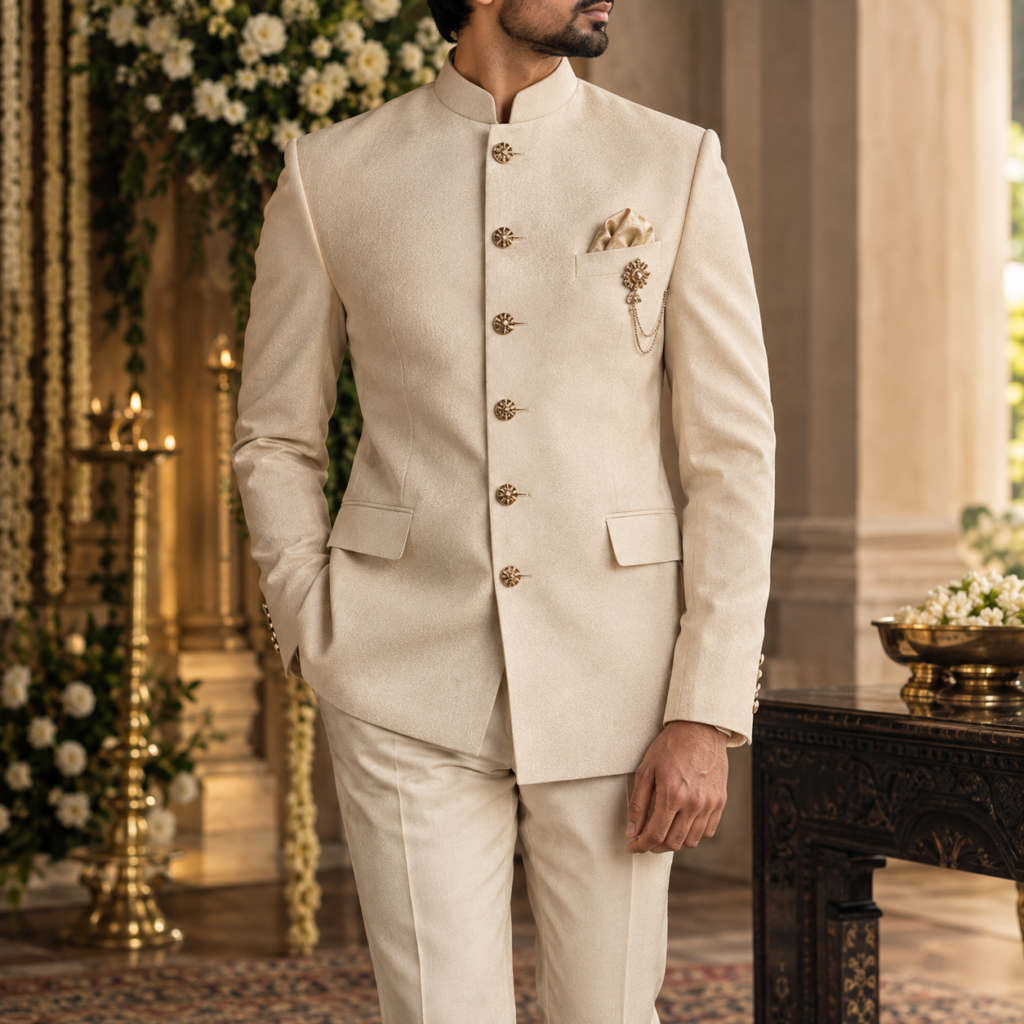
Key Takeaways
- The bandhgala suit for groom is the most structured, versatile choice in Indian wedding menswear – commanding at the baraat, refined at the reception, and photographically superior to most alternatives.
- Colour selection depends on season, venue type, and ceremony: ivory and champagne for daytime rituals; navy, maroon, and deep green for evening functions.
- Fabric determines comfort and silhouette – silk and brocade for winter ceremonies, cotton-silk and lightweight wool blends for summer and destination weddings.
- A bespoke bandhgala, built with full canvas interlining and fitted across three appointments, will outlast and outperform any ready-to-wear alternative by a considerable margin.
Why the Bandhgala Is the Groom’s Best Weapon
The bandhgala suit for groom is not simply an ethnic alternative to the sherwani. It is a garment with its own authority – structured, precise, and rooted in over four centuries of Indian tailoring tradition. Its origins trace to the Mughal courts of the 16th century, refined through Rajput warrior dress in the royal courts of Jodhpur, and eventually shaped into the closed-collar jacket recognised globally today. As Wikipedia’s entry on the Jodhpuri suit notes, the garment evolved from the Mughal jama and angrakha, absorbing Rajput warrior aesthetics before being refined into a waist-length fitted jacket worn by the Jodhpur royal family.
What distinguishes the bandhgala from every other option in the groom’s wardrobe is the standing collar – the bandhgala itself, meaning “closed neck.” That collar does something no open-lapel garment can replicate: it frames the face, elongates the neck, and projects an unmistakable authority. On a wedding stage, under mandap lighting or against a reception backdrop, the silhouette reads as complete. There is nothing left open, nothing casual, nothing unresolved.
Against the sherwani, the bandhgala holds a structural advantage. The sherwani is ceremonially rich but architecturally loose – its length and embroidery carry the visual weight. The bandhgala, by contrast, earns its presence through tailoring precision: the chest, the collar, the trouser break, the button alignment. A well-built bandhgala suit wedding look is as much about construction as it is about cloth.
The versatility is equally important. A bandhgala jodhpuri suit for groom moves across ceremonies with minimal adjustment – a pocket square swap, a different footwear choice, the addition or removal of a safa. The sherwani rarely crosses that boundary.
Bandhgala vs. Sherwani: Which One Is Right for Your Wedding?
The choice between a bandhgala and a sherwani is not a matter of one being superior – it is a matter of ceremony, body type, and the formality register the groom wishes to occupy.
| Factor | Bandhgala | Sherwani |
|---|---|---|
| Best ceremony | Reception, baraat, sangeet, pheras (modern) | Pheras, traditional baraat |
| Formality level | Formal to semi-formal | Most formal |
| Silhouette | Structured, waist-length, tailored | bandhgala pairs cleanly with red, gold, or ivory bridal wear. Maroon works alongside gold and champagne. Ivory suits almost every bridal palette. |
For summer weddings, lighter tones – ivory, champagne, blush – are both practical and photogenic. For winter evening receptions, deep jewel tones – maroon, navy, emerald – absorb and reflect light in a way that lighter shades cannot.
Fabric Selection for a Groom’s Bandhgala
Fabric choice determines three things simultaneously: how the suit drapes, how comfortable it is across a long ceremony day, and how it photographs. A bandhgala for groom built in the wrong fabric for the climate will compromise all three.
| Fabric | Climate | Ceremony Type | Key Quality |
|---|---|---|---|
| Pure Silk | Winter, Monsoon | Pheras, evening reception | Lustrous, holds structure, photographs richly |
| Velvet | Winter | Evening reception, indoor banquet | Maximum depth of colour; heavy – reserve for cooler months |
| Brocade | Winter | Traditional pheras, baraat | Ornate texture; pairs with simpler accessories |
| Raw Silk / Dupioni | Year-round | All ceremonies | Textured, breathable, less formal than pure silk |
| Wool Blend (Super 100s–130s) | Winter, Monsoon | All ceremonies | Best drape and structure; the tailor’s preferred canvas |
| Cotton-Silk | Summer, Spring | Daytime pheras, outdoor events | Breathable, lightweight, holds colour well |
| Linen Blend | Summer | Destination weddings, beach | Casual-formal; best in ivory or natural tones |
The fabric also determines how well the canvas interlining – the internal structure that gives a bespoke bandhgala its shape – performs over a long day. A wool blend or raw silk accepts canvas construction most naturally, allowing the chest piece to mold to the body across the fitting process. Velvet and brocade require additional care in construction: the collar must be reinforced with a stiffer inner layer to prevent the pile from collapsing at the stand.
For most Indian weddings – where the groom is on his feet for eight to twelve hours – a cotton-silk or lightweight wool blend in summer, and a raw silk or Super 100s wool blend in winter, represents the most practical choice without sacrificing formality.
Bespoke vs. Ready-to-Wear: What Changes for a Groom
A ready-to-wear bandhgala is sized to a standard body. A bespoke bandhgala is built for one body – yours. The distinction sounds simple; the practical difference is significant.
What bespoke changes:
- Collar height and stand. The bandhgala collar is the garment’s defining feature. In a bespoke commission, the collar height is set to the individual’s neck length, the stand is padded to the correct stiffness, and the closure is aligned precisely at the throat. A standard RTW collar sits at a generic height – often too low on a long neck, too high on a shorter one.
- Chest canvas construction. A properly bespoke bandhgala uses a full or half canvas interlining – a floating layer of horsehair and linen hand-basted between the outer cloth and the lining. This canvas molds to the wearer’s chest over successive fittings, creating a three-dimensional curve that no fused interlining can replicate. As Made2Measure’s guide to bespoke canvas construction notes, a canvassed jacket “memorizes your posture, creating a fit that grows more personal with each wear.”
- Button count and placement. The number of buttons on a bandhgala – typically five to seven – and their spacing relative to the chest and waist are calibrated to the individual’s torso length. Misaligned buttons on a closed-neck jacket are immediately visible; there is no lapel to conceal the error.
- Trouser construction. Bespoke trousers are cut to the groom’s exact seat, thigh, and inseam measurements. The break at the shoe is set deliberately – not approximated.
- Lining and monogram. The lining fabric, colour, and any monogram placement are chosen by the groom. A silk lining in a contrasting colour, or a hand-embroidered initial inside the collar, are details invisible to the room but known to the wearer.
The fitting process:
A bespoke bandhgala commission at our atelier follows three appointments across eight to twelve weeks. The first appointment is for measurements and cloth selection. The second is a basted fitting – the garment assembled in its rough form, collar and chest canvas hand-basted, allowing adjustments before the cloth is cut to final shape. The third is the finishing fitting, where the completed suit is worn and assessed under natural light.
What to ask your tailor before commissioning:
- Is the canvas floating or fused?
- How is the collar stand constructed and reinforced?
- How many fittings are included?
- What is the lead time from commission to delivery?
- Can the lining and button choice be customised?
A tailor who cannot answer these questions with specificity is not building bespoke.
How to Style a Bandhgala Suit for Your Wedding Day
The bandhgala’s closed collar removes the need for a tie or cravat, which simplifies the accessory equation considerably. Every element added to the look should earn its place.
Pocket square. A silk pocket square in a complementary tone – not a matching one – adds the only visible colour accent on the jacket’s exterior. For a navy bandhgala, ivory or champagne silk. For maroon, gold or deep burgundy. Fold it simply: a flat presidential fold or a single-point fold. The pocket square should be seen, not performed.
Brooch or sarpech. A small brooch at the collar – or a sarpech pinned to the safa – adds a jewellery element without competing with the suit’s structure. Antique gold, polished silver, or a single stone setting work best. Avoid oversized or heavily encrusted pieces; the bandhgala’s collar is already the focal point.
Safa or turban. The safa is the most powerful accessory in the groom’s arsenal. It adds height, frames the face, and anchors the entire look. For a bespoke bandhgala suit wedding, the safa fabric should echo – not match – the suit’s colour. A maroon bandhgala pairs with a gold or ivory safa. A navy suit works with a deep red or champagne safa.
Footwear. Three options work consistently well:
- Mojaris or juttis – traditional, embroidered, and appropriate for all ceremonies. Choose a colour that picks up one element of the suit or safa.
- Derby shoes or Oxford brogues – for a more contemporary register, particularly at urban hotel receptions.
- Loafers in suede or leather – for the groom who wants comfort across a long day without sacrificing formality.
Layering. A waistcoat or bandi beneath the bandhgala jacket adds a layer of visual complexity and warmth for winter ceremonies. Choose a contrasting fabric – brocade under a wool bandhgala, or silk under a raw silk jacket. The waistcoat should be visible only at the lower button, not worn open.
Bandhgala for Every Wedding Ceremony
One of the most practical questions a groom faces is whether a single bandhgala suit covers the entire wedding schedule, or whether multiple looks are warranted. The answer depends on the number of events, their formality level, and the groom’s appetite for change.
Baraat. The baraat calls for the groom’s most commanding look. A rich fabric – silk, brocade, or velvet in winter – in a deep or auspicious colour. The safa is essential. This is the moment for the full bespoke bandhgala jodhpuri suit for groom, dressed to its maximum.
Pheras (wedding ceremony). The pheras are the most sacred moment of the day. Some grooms prefer the sherwani here for its traditional weight; others wear the bandhgala throughout. If the bandhgala is worn for pheras, keep the accessories restrained – the ceremony’s gravity should not be competed with.
Reception. The reception is where the bandhgala performs best. The structured silhouette reads sharply under banquet lighting. A change of pocket square, a different pair of shoes, or the removal of the safa in favour of a clean collar is sufficient to signal a new register without requiring a full outfit change.
Sangeet. The sangeet is the most relaxed of the formal events. A lighter fabric – cotton-silk, linen blend – in a softer colour allows the groom to move freely. A bandhgala for this event need not be the primary wedding suit; a second, lighter commission is worth considering for grooms with a full three-day schedule.
The practical verdict: For most Indian weddings with two to three events, one bespoke bandhgala in a versatile colour – navy, maroon, or ivory – can be styled differently across ceremonies. For a four-day wedding schedule, two commissions – one formal, one lighter – is the more considered approach.
Frequently Asked Questions
Is a bandhgala better than a sherwani for the groom?
Neither is categorically better – they serve different purposes. The sherwani is the more traditional choice for pheras and carries greater ceremonial weight. The bandhgala is more structured, more versatile, and more flattering across a wider range of body types. Many grooms now wear a sherwani for the ceremony and a bandhgala for the reception, which gives the day two distinct visual moments. If the groom is attending only one event, the bandhgala for groom is the stronger all-purpose choice.
What is the best colour for a groom’s bandhgala?
Navy is the most consistently flattering and versatile groom bandhgala colour – it photographs well in all light conditions, pairs with most bridal palettes, and reads as formal without being heavy. Maroon and ivory are close seconds. For winter evening receptions, deep green and champagne are increasingly popular. The best colour is ultimately the one that works with the venue, the season, and the bride’s palette – not simply personal preference in isolation.
How early should a groom commission a bespoke bandhgala?
Eight to twelve weeks before the wedding is the standard lead time for a bespoke commission. This allows for three fittings, any fabric sourcing, and the hand-finishing work that distinguishes bespoke construction. Commissioning closer to the wedding date compresses the fitting process and risks a garment that is completed but not fully refined. For destination weddings or complex embroidery requests, twelve to sixteen weeks is more appropriate.
Can a bandhgala be worn for the reception?
The reception is, in fact, the ceremony for which the bandhgala suit wedding look is best suited. The structured silhouette reads sharply under banquet and stage lighting. The groom can change accessories – pocket square, footwear, safa – to signal a shift from the ceremony look while wearing the same jacket. The bandhgala’s clean lines also photograph well against reception backdrops.
What fabric is best for a summer wedding bandhgala?
For a summer or destination wedding, cotton-silk is the most practical choice – it is breathable, holds colour well, and accepts canvas construction cleanly. A lightweight linen blend is an alternative for very warm outdoor venues. Avoid velvet and heavy brocade in summer; they retain heat and lose their structure in humidity. A Super 100s wool blend is acceptable for air-conditioned indoor venues even in summer.
What is the difference between a bandhgala and a Jodhpuri suit?
The terms are often used interchangeably, but there is a technical distinction. Bandhgala refers specifically to the closed-collar jacket – the defining construction element. Jodhpuri suit refers to the complete ensemble: the bandhgala jacket worn with matching trousers, and sometimes a waistcoat. In practice, when a groom commissions a bespoke bandhgala jodhpuri suit for groom, he is commissioning the full three-piece ensemble built around the closed-collar jacket.
