
White Tuxedo Suit for Men: Complete Guide to Fit, Fabric & Occasions
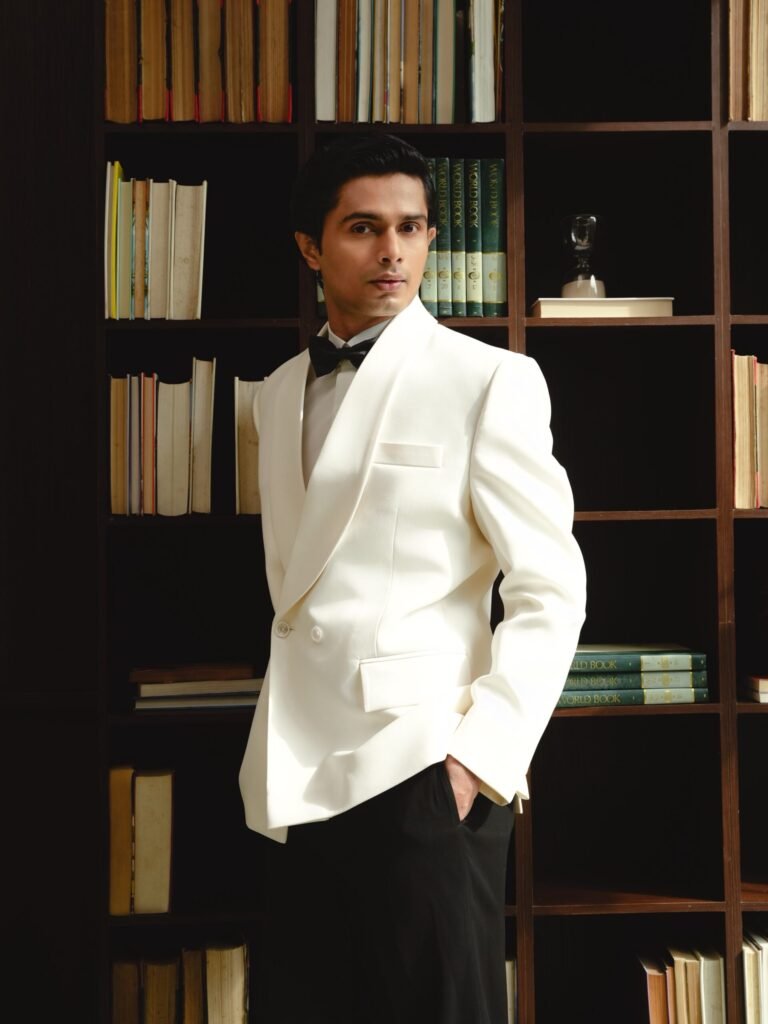
A white tuxedo suit for men is a formal evening jacket — traditionally in ivory or off-white — worn with black trousers, a black bow tie, and satin lapel facing, following the same construction as a classic black tuxedo but reversing the jacket colour for a standout statement look. It’s correct for black-tie events held in warm climates or evening hours, for grooms, and for high-visibility occasions like receptions, galas, and summer weddings. It is not interchangeable with a plain white suit, which has no satin lapels and is worn for daytime or business settings. As a tailor who cuts formal wear out of my atelier in Thane, this is one of the most-requested pieces every wedding and event season — and also one of the most misunderstood. Here’s what actually separates a white tuxedo from a white suit, and how to get the fit right. What Defines a White Tuxedo (Not Just a White Suit) A genuine tuxedo — white or black — is identified by three construction details, not by colour alone: If a garment is white top to bottom with plain lapels and no satin detailing, it’s a white suit, not a white tuxedo — correct for daytime events, not for black-tie evening wear. White Tuxedo vs. Black Tuxedo vs. White Suit Feature White Tuxedo Black Tuxedo White Suit Lapel Satin-faced (peak/shawl) Satin-faced (peak/shawl) Plain, no satin Trousers Black, satin stripe Black, satin stripe White or ivory, matching Dress code Black tie (evening) Black tie (evening) Business/day formal Best setting Evening receptions, gala, groom Formal evening events Daytime wedding, summer business Standout factor High — contrast look Classic, understated Moderate When to Wear a White Tuxedo It is generally not worn to daytime formal events, office functions, or traditional ceremonial functions where sherwanis or Bandhgalas are the cultural norm — a white tuxedo belongs specifically to Western black-tie evening contexts. Fabric and Fit Considerations For Indian climates, I steer most clients toward a wool-mohair blend or a lightweight wool-silk mix — both hold a crisp ivory-white shade without the fabric looking flat or overly stiff under evening lighting. Pure white can wash out under flash photography, so I often recommend a soft ivory or off-white shade instead of stark white; it photographs warmer and is more forgiving on most skin tones. Fit details that matter most on a white tuxedo, because the lighter colour makes any looseness or pulling far more visible than on black: How We Tailor It at the Atelier Every white tuxedo order starts with fabric selection, since the shade of white and the weight of the cloth decide how the final garment photographs and drapes — this is not a detail I leave to a swatch book alone; I review it against the client’s skin tone and the event’s lighting. From there we move to a first fitting for shoulder and chest shaping, followed by lapel and trouser finishing at the final fitting. Most white tuxedo orders take two to three weeks from first measurement to delivery, depending on fabric sourcing and season. Frequently Asked Questions Is a white tuxedo appropriate for a daytime wedding? Not traditionally. A white tuxedo follows black-tie evening convention; for daytime formal events, a white suit without satin lapels is the correct choice. Can I wear a white tuxedo jacket with white trousers instead of black? It’s possible for a fully white look, but it moves away from classic black-tie convention and reads as more fashion-forward than formal. Black trousers with a satin stripe remain the traditional and safest pairing. What shirt and accessories go with a white tuxedo? A classic white tuxedo shirt with a wing or turndown collar, a black satin bow tie, and black formal shoes — the same accessory rules as a black tuxedo apply. Does a white tuxedo suit all skin tones? Most skin tones suit an off-white or ivory shade better than stark white, which can appear flat under bright or flash lighting. I recommend testing fabric swatches against skin tone before finalising. How is a white tuxedo different from a white Nehru jacket or Bandhgala? A white tuxedo is a Western black-tie garment with satin lapels and bow tie, built for evening formal events. A white Bandhgala or Nehru jacket has a closed mandarin collar, no satin lapels, and belongs to Indian formal and ceremonial dress codes instead. In short: a white tuxedo suit for men is a satin-lapelled, black-tie evening jacket in white or ivory, paired with black trousers and a black bow tie — distinct from a plain white suit, and best suited to evening weddings, galas, and receptions rather than daytime or traditional ceremonial events. Ready for a white tuxedo built to your measurements? Book a consultation or browse our wedding suit collection to see
Bandhgala Suit for Groom: The Complete Wedding Style Guide
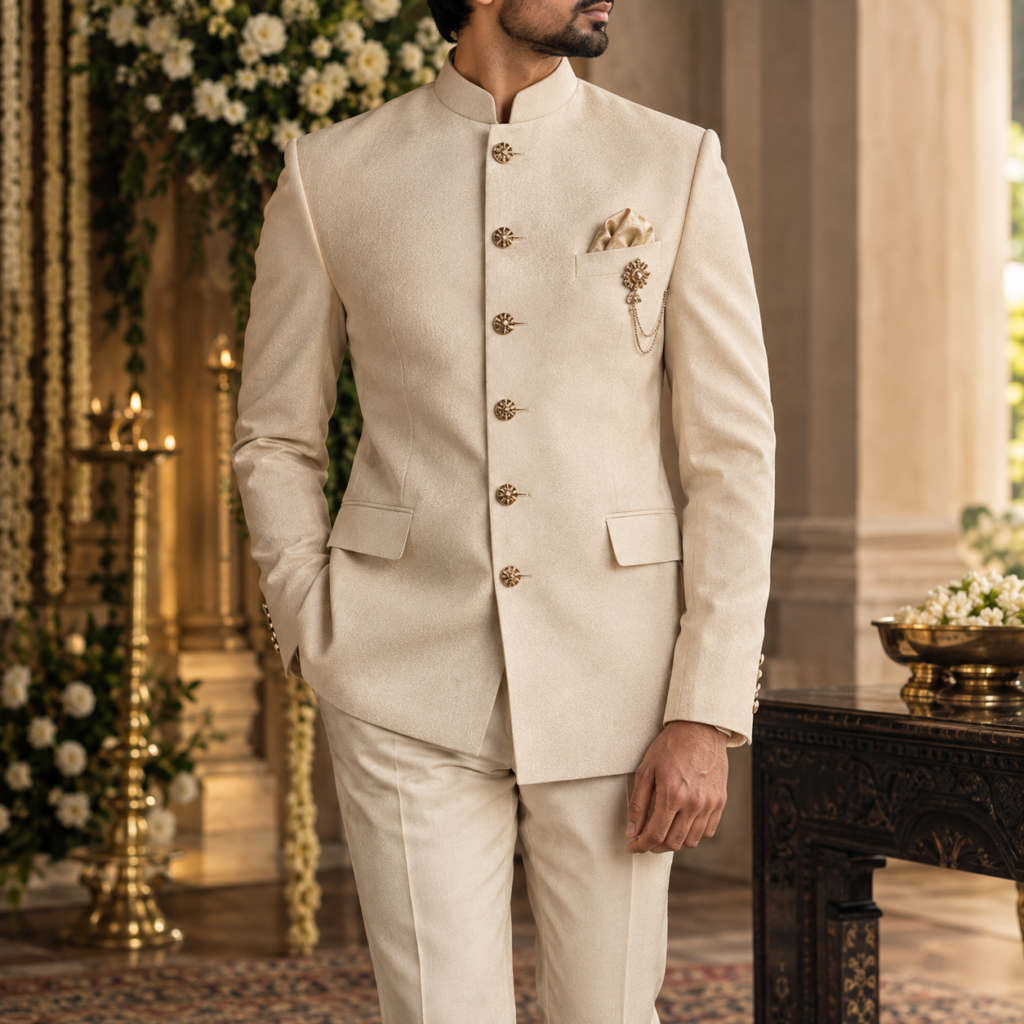
Key Takeaways Why the Bandhgala Is the Groom’s Best Weapon The bandhgala suit for groom is not simply an ethnic alternative to the sherwani. It is a garment with its own authority – structured, precise, and rooted in over four centuries of Indian tailoring tradition. Its origins trace to the Mughal courts of the 16th century, refined through Rajput warrior dress in the royal courts of Jodhpur, and eventually shaped into the closed-collar jacket recognised globally today. As Wikipedia’s entry on the Jodhpuri suit notes, the garment evolved from the Mughal jama and angrakha, absorbing Rajput warrior aesthetics before being refined into a waist-length fitted jacket worn by the Jodhpur royal family. What distinguishes the bandhgala from every other option in the groom’s wardrobe is the standing collar – the bandhgala itself, meaning “closed neck.” That collar does something no open-lapel garment can replicate: it frames the face, elongates the neck, and projects an unmistakable authority. On a wedding stage, under mandap lighting or against a reception backdrop, the silhouette reads as complete. There is nothing left open, nothing casual, nothing unresolved. Against the sherwani, the bandhgala holds a structural advantage. The sherwani is ceremonially rich but architecturally loose – its length and embroidery carry the visual weight. The bandhgala, by contrast, earns its presence through tailoring precision: the chest, the collar, the trouser break, the button alignment. A well-built bandhgala suit wedding look is as much about construction as it is about cloth. The versatility is equally important. A bandhgala jodhpuri suit for groom moves across ceremonies with minimal adjustment – a pocket square swap, a different footwear choice, the addition or removal of a safa. The sherwani rarely crosses that boundary. Bandhgala vs. Sherwani: Which One Is Right for Your Wedding? The choice between a bandhgala and a sherwani is not a matter of one being superior – it is a matter of ceremony, body type, and the formality register the groom wishes to occupy. Factor Bandhgala Sherwani Best ceremony Reception, baraat, sangeet, pheras (modern) Pheras, traditional baraat Formality level Formal to semi-formal Most formal Silhouette Structured, waist-length, tailored bandhgala pairs cleanly with red, gold, or ivory bridal wear. Maroon works alongside gold and champagne. Ivory suits almost every bridal palette. For summer weddings, lighter tones – ivory, champagne, blush – are both practical and photogenic. For winter evening receptions, deep jewel tones – maroon, navy, emerald – absorb and reflect light in a way that lighter shades cannot. Fabric Selection for a Groom’s Bandhgala Fabric choice determines three things simultaneously: how the suit drapes, how comfortable it is across a long ceremony day, and how it photographs. A bandhgala for groom built in the wrong fabric for the climate will compromise all three. Fabric Climate Ceremony Type Key Quality Pure Silk Winter, Monsoon Pheras, evening reception Lustrous, holds structure, photographs richly Velvet Winter Evening reception, indoor banquet Maximum depth of colour; heavy – reserve for cooler months Brocade Winter Traditional pheras, baraat Ornate texture; pairs with simpler accessories Raw Silk / Dupioni Year-round All ceremonies Textured, breathable, less formal than pure silk Wool Blend (Super 100s–130s) Winter, Monsoon All ceremonies Best drape and structure; the tailor’s preferred canvas Cotton-Silk Summer, Spring Daytime pheras, outdoor events Breathable, lightweight, holds colour well Linen Blend Summer Destination weddings, beach Casual-formal; best in ivory or natural tones The fabric also determines how well the canvas interlining – the internal structure that gives a bespoke bandhgala its shape – performs over a long day. A wool blend or raw silk accepts canvas construction most naturally, allowing the chest piece to mold to the body across the fitting process. Velvet and brocade require additional care in construction: the collar must be reinforced with a stiffer inner layer to prevent the pile from collapsing at the stand. For most Indian weddings – where the groom is on his feet for eight to twelve hours – a cotton-silk or lightweight wool blend in summer, and a raw silk or Super 100s wool blend in winter, represents the most practical choice without sacrificing formality. Bespoke vs. Ready-to-Wear: What Changes for a Groom A ready-to-wear bandhgala is sized to a standard body. A bespoke bandhgala is built for one body – yours. The distinction sounds simple; the practical difference is significant. What bespoke changes: The fitting process: A bespoke bandhgala commission at our atelier follows three appointments across eight to twelve weeks. The first appointment is for measurements and cloth selection. The second is a basted fitting – the garment assembled in its rough form, collar and chest canvas hand-basted, allowing adjustments before the cloth is cut to final shape. The third is the finishing fitting, where the completed suit is worn and assessed under natural light. What to ask your tailor before commissioning: A tailor who cannot answer these questions with specificity is not building bespoke. How to Style a Bandhgala Suit for Your Wedding Day The bandhgala’s closed collar removes the need for a tie or cravat, which simplifies the accessory equation considerably. Every element added to the look should earn its place. Pocket square. A silk pocket square in a complementary tone – not a matching one – adds the only visible colour accent on the jacket’s exterior. For a navy bandhgala, ivory or champagne silk. For maroon, gold or deep burgundy. Fold it simply: a flat presidential fold or a single-point fold. The pocket square should be seen, not performed. Brooch or sarpech. A small brooch at the collar – or a sarpech pinned to the safa – adds a jewellery element without competing with the suit’s structure. Antique gold, polished silver, or a single stone setting work best. Avoid oversized or heavily encrusted pieces; the bandhgala’s collar is already the focal point. Safa or turban. The safa is the most powerful accessory in the groom’s arsenal. It adds height, frames the face, and anchors the entire look. For a bespoke bandhgala suit wedding, the safa fabric should echo – not match
Merino Wool for Indian Weather: A Tailor’s Guide
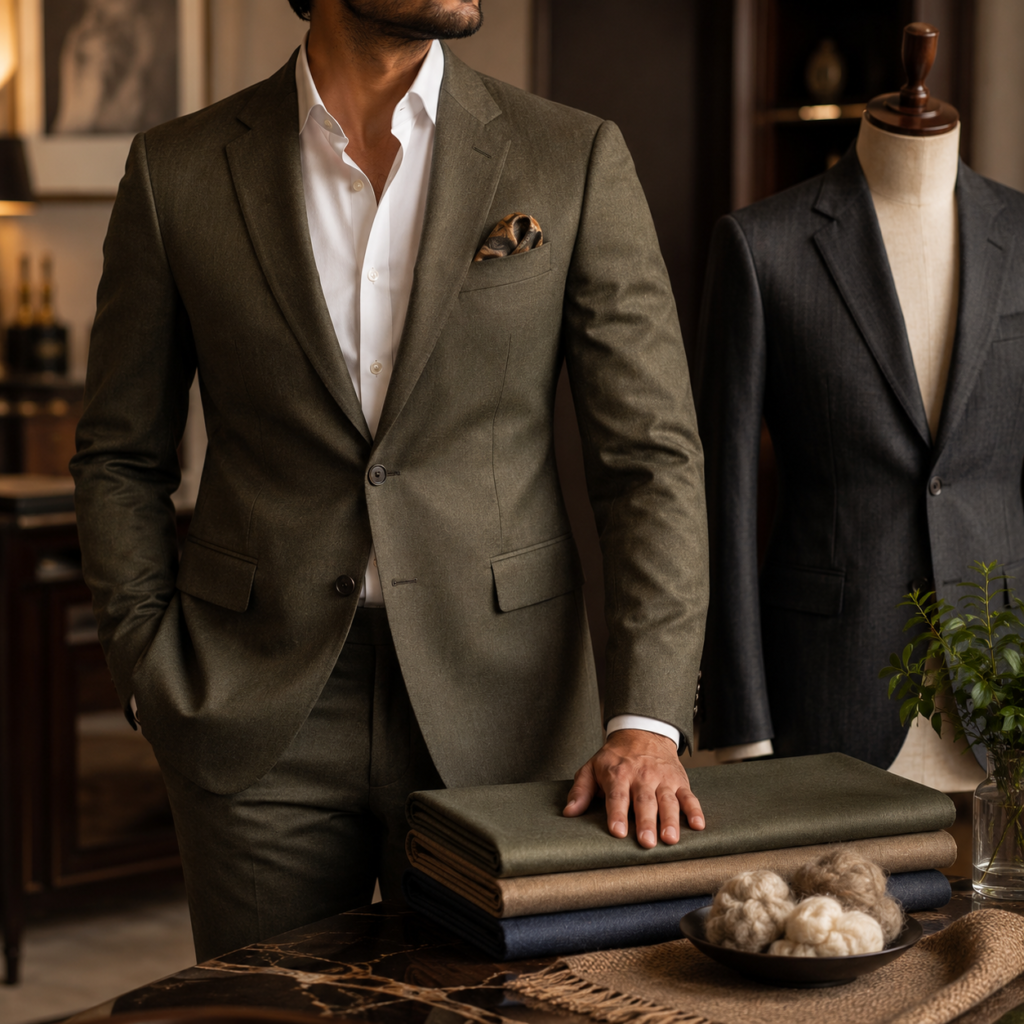
Yes, merino wool and super wool fabric can be worn in India, provided the grade and weave are matched to the specific climate zone. For tropical humid cities such as Mumbai and Chennai, a Super 110s–120s merino in an open tropical weave is the correct choice; for highland cities such as Bengaluru or Shimla, Super 130s–150s in a plain or high-twist weave performs well year-round. Super 200s and heavier flannel constructions are impractical in every Indian climate below 1,500 metres altitude. Super Wool and Merino Wool in Indian Weather – A Tailor’s Guide The question arrives at the atelier regularly: can merino wool for Indian weather actually work, or is wool simply a European fabric for European winters? The answer is unambiguous – wool works in India, and in several climate zones it outperforms the alternatives. The condition is precision. The wrong grade in the wrong city is uncomfortable; the right grade in the right weave is among the most refined choices a man can make for formal, professional, or ceremonial dress. This guide addresses two distinct but related subjects: the specific properties of merino wool that make it suitable for the subcontinent, and the Super wool numbering system as a practical selection tool for Indian buyers. These are not the same thing, and conflating them leads to poor fabric decisions. India Has Four Climates. Your Wool Needs to Know That. Wool performs well in India when it is matched to the correct climate zone. The error most buyers make is treating India as a single climate – it is not. The subcontinent spans four distinct suiting-relevant zones, each with different temperature ranges, humidity profiles, and seasonal variation. A fabric appropriate for Bengaluru is not appropriate for Kolkata; a cloth that works in Jaipur in January fails in July. The table below maps each zone to the wool grades and weaves that serve it best. Climate Zone Cities Recommended Wool Grade Recommended Weave Avoid Tropical Humid Mumbai, Chennai, Kolkata, Kochi Super 110s–120s merino Open tropical weave Flannel, tweed, heavy twill, S150+ Semi-Arid Delhi (Oct–Mar), Jaipur, Pune Super 120s–130s Plain weave, high-twist Flannel, S160+ in summer months Highland / Temperate Bengaluru, Shimla, Ooty, Mussoorie Super 130s–150s Plain weave, high-twist Open tropical weave in winter Arid Rajasthan interior, Jodhpur, Bikaner Super 110s–120s (Oct–Feb only) Tropical or open plain weave Any wool June–September Tropical humid zones (Mumbai, Chennai, Kolkata) present the most demanding conditions: temperatures between 28–38°C combined with relative humidity frequently above 70%. Here, the fibre must manage moisture vapour actively, and the weave must allow air circulation. Super 110s–120s merino in a tropical weave – woven with an open structure at 200–260 g/m² – is the appropriate specification. Heavier constructions trap heat and moisture against the body. Semi-arid zones (Delhi, Jaipur, Pune) offer more seasonal range. Delhi winters (November through February) are genuine wool weather, permitting Super 120s–130s in a plain weave at 260–300 g/m². The summer months, however, are extreme; wool is not the correct choice from May through August in these cities unless the fabric is exceptionally light and the weave open. Highland and temperate zones (Bengaluru, Shimla, Ooty) are where wool performs most consistently across the year. Bengaluru’s average temperature range of 15–33°C, with moderate humidity, is almost precisely the operating window of a well-chosen Super 130s–150s plain weave. Shimla and Ooty in cooler months support the upper end of that range. Arid zones (Rajasthan interior) are wool-viable only in the cooler months – October through February – when temperatures drop to 8–22°C. A Super 110s–120s in a light open weave at 220–250 g/m² is workable for formal occasions. Outside those months, the dry heat exceeds what any wool construction can manage comfortably. What Is Merino Wool – and Why Does It Behave Differently? Merino wool is a natural protein fibre sourced from the Merino breed of sheep, distinguished from standard wool by its exceptionally fine fibre diameter. Standard wool fibres measure 30 microns or more in diameter; merino fibres range from approximately 15 to 24 microns, with superfine grades falling between 15 and 18.5 microns. This distinction is not merely technical – it determines whether a fabric feels comfortable against bare skin or causes the prickle response that makes coarser wool unwearable in warm weather. The relevance for merino wool India buyers is direct: finer fibres bend more readily under contact with the skin, reducing the mechanical irritation that coarser fibres cause. A Super 120s merino suit worn without a shirt layer in a warm boardroom remains comfortable; the same construction in a standard 30-micron wool does not. Moisture management is the property that most distinguishes merino from alternatives in humid Indian cities. Merino wool is hygroscopic – it absorbs moisture vapour from the microclimate between the fabric and the skin, drawing it into the fibre core before it reaches the surface as liquid sweat. The fibre can absorb up to 35% of its own weight in moisture vapour before it begins to feel damp to the touch. For a man wearing a wool suit India through a wedding reception in Mumbai or a full day of client meetings in Chennai, this property is not a luxury – it is a functional requirement. Odour resistance follows from the same hygroscopic mechanism. Merino fibres absorb odour molecules along with moisture, preventing the surface accumulation that causes synthetic and cotton fabrics to smell after extended wear. For long event days – corporate presentations, ceremonies, multi-day travel – this extends the effective wear life of a garment between dry cleans. Temperature regulation is the third distinguishing property. Merino wool is active across a temperature range of approximately 10–30°C, making it viable across Indian seasons in the right grade. The fibre responds to body temperature: in cooler conditions, the crimp structure traps warm air; in warmer conditions, the moisture-wicking action and breathability of the open structure cool the wearer. No synthetic fabric replicates this dual behaviour. The comparison below sets merino against standard wool for Indian buyers: Property Merino Wool
Bespoke Tailor in Thane – Shubham Shinde Atelier
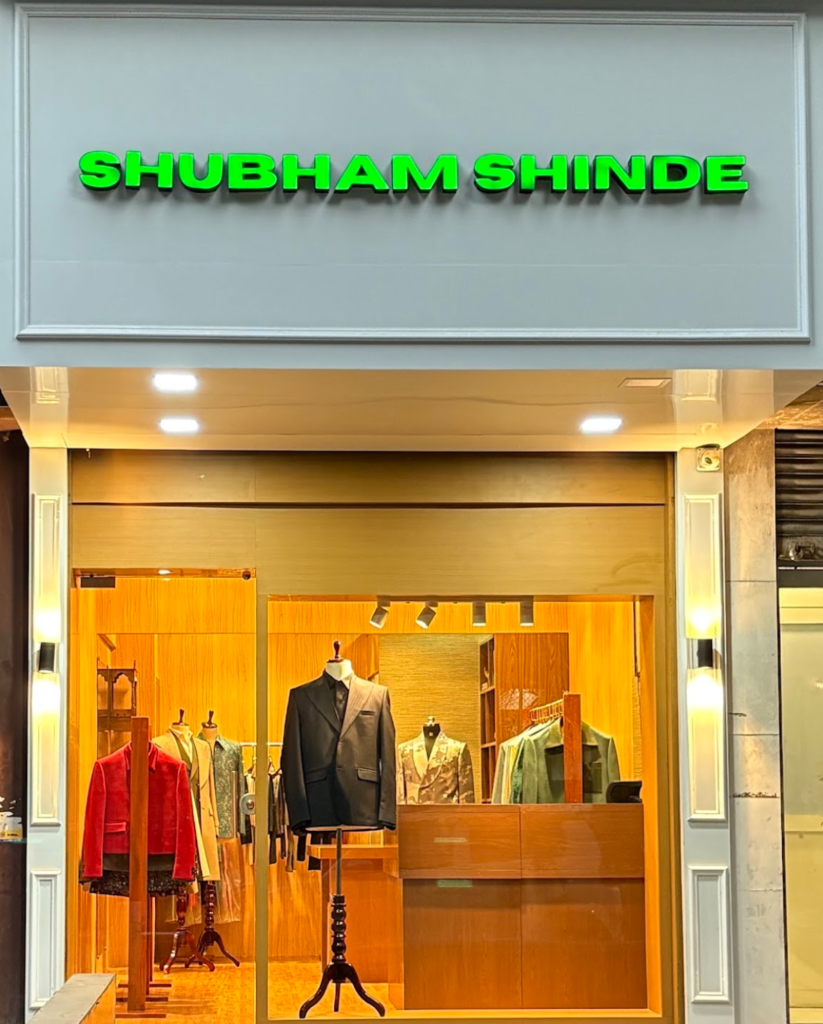
Shubham Shinde Atelier is a luxury bespoke menswear atelier located in Naupada, Thane West, Maharashtra – offering custom suits, bandhgala jodhpuri suits, jackets, shirts, and trousers for the modern gentleman. Every garment is drafted from an individual pattern, fitted across multiple appointments, and constructed by hand. Where ready-to-wear offers convenience and standardisation, bespoke offers precision: a garment built to a single body, a single occasion, and a single standard of craft. Bespoke Tailor in Thane – Shubham Shinde Atelier Shubham Shinde Atelier is a bespoke tailor in Thane serving clients across Thane West, Mumbai, Navi Mumbai, and greater Maharashtra. The atelier operates from Naupada – a short distance from Thane station – on an appointment basis, with each commission receiving the full attention of the cutter from first consultation through to final delivery. Bespoke Tailoring in Thane – What It Actually Means Bespoke tailoring begins with a blank sheet. No block, no standard size, no pre-existing pattern adapted to approximate a fit. A bespoke garment is drafted from scratch – from the client’s individual measurements, posture, and proportions – and fitted across a minimum of two appointments before the final construction is completed. The result is a garment that fits no one else on earth, because it was never intended to. Thane’s professional and social landscape makes this relevant in ways it was not a decade ago. A growing concentration of corporate professionals, established business families, and a wedding market that spans everything from intimate receptions to multi-day ceremonies has created genuine demand for formal menswear that performs at the highest level. A suit bought off a rack – even an expensive one – cannot account for a dropped shoulder, an asymmetric chest, or the precise collar height that makes a bandhgala sit correctly. Bespoke can. The distinction between bespoke, made-to-measure, and ready-to-wear is frequently misunderstood. The table below clarifies the three categories across the dimensions that matter most. Bespoke Made to Measure Ready-to-Wear Pattern origin Drafted individually from scratch Existing block adjusted to measurements Standard block, no adjustment Fittings Minimum 2–3 (baste + final) Typically 1, sometimes none None Fit precision Highest – accounts for posture and asymmetry Moderate – adjusts for key measurements Standardised – fits a statistical average Timeline 4–8 weeks 2–4 weeks Immediate Price range ₹25,000–₹1,50,000+ ₹12,000–₹40,000 ₹5,000–₹30,000 What We Make – The Shubham Shinde Atelier Range At our atelier, the range covers every dimension of formal and occasion menswear – from the boardroom to the baraat. Each garment category is approached with the same commitment to individual construction: a pattern drafted for the client, a canvas chest built by hand, and a fit confirmed across multiple appointments. Bespoke Suits. Our suits – formal, corporate, and wedding – are constructed with a floating canvas chest that moulds to the wearer’s body over time, hand-sewn buttonholes worked with a gimp thread, and a sleeve pitch set to the individual’s shoulder angle. A custom suit in Thane at this standard is not a product category; it is a commission. The result wears differently from anything produced at scale. Bandhgala and Jodhpuri Suits. The bandhgala jodhpuri suit is India’s most authoritative ethnic formal silhouette – a closed-collar coat paired with matching tailored trousers, equivalent in ceremony to Western black tie. The collar roll, the grain alignment of the front panel, and the precise height of the stand collar are details that cannot be standardised. Each bandhgala we construct is fitted at the collar specifically for the client’s neck circumference and pitch. Jackets and Blazers. Structured, unstructured, and occasion-specific – our jackets range from a full-canvas formal blazer in tropical wool to a softer, deconstructed linen jacket appropriate for a daytime event. The shoulder construction, the chest canvas weight, and the lining choice are all determined by the garment’s intended occasion and the client’s preference for drape versus definition. Shirts. Formal shirts, casual shirts, and occasion shirts – each cut from the client’s individual collar, chest, and sleeve measurements. A bespoke shirt eliminates the compromises that plague even premium ready-to-wear: the collar that gaps, the sleeve that is too short, the chest that pulls across the button-stand. Our formal shirts are constructed with a fitted body, a precisely sized collar, and a sleeve length that accounts for the individual’s arm. Trousers. Formal trousers, pleated trousers, and flat-front trousers – each cut to the client’s seat, rise, and inseam. The trouser break – the amount of fabric that rests on the shoe – is set to the client’s preference and the occasion’s formality. A clean no-break hem reads as contemporary and precise; a half-break is the most versatile choice for formal wear. The Bespoke Process – From First Consultation to Final Fitting A bespoke commission at Shubham Shinde Atelier follows a structured sequence. Each step has a purpose; none is abbreviated. The timeline below reflects the reality of hand construction – not a commercial convenience. Step 1 – Consultation and Fabric Selection At our atelier, we begin every commission with a consultation. The client’s occasion, timeline, and aesthetic preferences are established before a single measurement is taken. Fabric selection follows: we present cloths appropriate to the occasion, the season, and the client’s stated preferences, and discuss the construction implications of each choice – how a tropical wool will perform across a full day of ceremony, how a silk blend will drape under a structured canvas. This appointment typically takes 45–60 minutes. No measurement is rushed; no fabric is selected without the client’s full understanding of what it will produce. Step 2 – Measurement and Pattern Drafting At our atelier, we take a full set of measurements – typically 20 or more points for a coat, including chest, waist, seat, shoulder width, neck circumference, sleeve length, and back length, as well as posture observations that do not appear on a tape measure. From these measurements, an individual pattern is drafted: not a block adjusted by a computer, but a paper pattern drawn for this client’s specific proportions. The pattern drafting
The Bandhgala Jodhpuri Suit: A Complete Guide to India’s Most Commanding Ethnic Silhouette
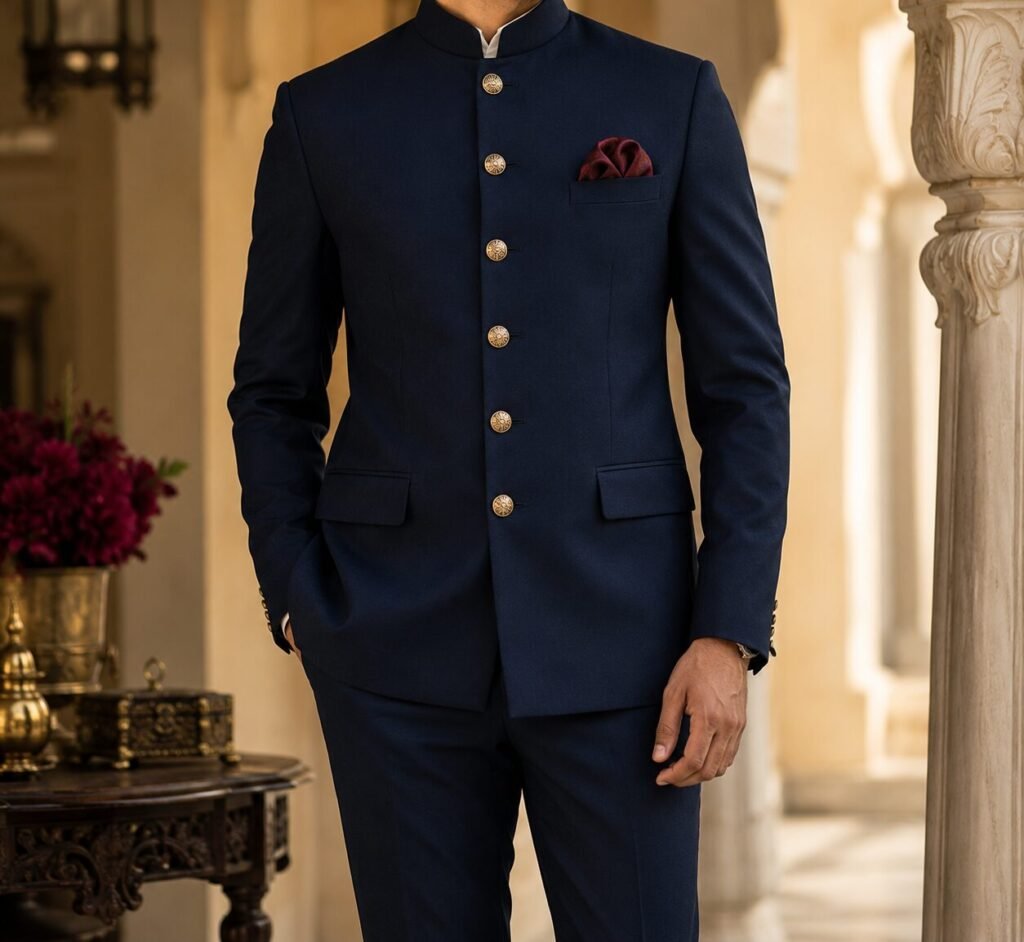
A bandhgala jodhpuri suit is a complete two-piece Indian formal ensemble comprising a structured, lapel-free coat with a closed stand collar (the bandhgala) and a pair of matching tailored trousers – together forming what is widely regarded as India’s most authoritative ethnic silhouette for men. It is worn at weddings, formal receptions, diplomatic engagements, and high-ceremony festive occasions. The key distinction from a plain bandhgala jacket is the matching trouser set: the jodhpuri element transforms a standalone jacket into a coordinated suit of equal formality to a Western black-tie ensemble. In bespoke form, it is constructed with a floating canvas chest, hand-sewn buttonholes, and a precisely rolled collar – details that separate a garment of genuine craft from a mass-produced approximation. The Bandhgala Jodhpuri Suit: A Complete Guide to India’s Most Commanding Ethnic Silhouette Few garments in the canon of men’s formal dress carry the structural authority of the bandhgala jodhpuri suit. Rooted in the princely courts of Rajasthan, refined through a century of tailoring evolution, and now worn at the highest levels of Indian ceremony and diplomacy, it occupies a position in Indian menswear that has no direct Western equivalent. It is neither a suit in the European sense nor a traditional sherwani – it is something more precise: a garment that communicates cultural identity through disciplined construction rather than decorative excess. This guide covers every dimension of the bandhgala jodhpuri suit – its history, anatomy, fabric options, fit requirements, occasion styling, current design directions, and long-term care – written from the perspective of practitioners who cut and construct these garments by hand. What Is a Bandhgala Jodhpuri Suit? A bandhgala jodhpuri suit is a structured two-piece Indian formal suit consisting of a closed-collar coat – the bandhgala – paired with matching tailored trousers cut from the same cloth. The term combines two distinct garment identifiers: bandhgala (from Hindi, meaning “closed neck”) refers to the stand collar that fastens at the throat without lapels, and jodhpuri denotes the complete suit format – coat and trouser – that originated in the royal court of Jodhpur in Rajasthan. The distinction between a bandhgala jacket and a bandhgala jodhpuri suit is precise and meaningful. A bandhgala jacket is a standalone upper garment, typically worn over churidars, trousers, or kurta-pyjama. A bandhgala jodhpuri suit is a coordinated two-piece ensemble in which the coat and trouser are cut from identical fabric, creating a unified formal silhouette of the highest ceremonial register. Comparison: Bandhgala Jacket vs Bandhgala Jodhpuri Suit Feature Bandhgala Jacket Bandhgala Jodhpuri Suit Garment components Jacket only Structured coat + matching trousers Collar style Closed stand collar Closed stand collar Occasions Semi-formal to formal; festive Formal to black-tie; weddings; diplomatic Formality level High Very high – equivalent to Western black tie Styling flexibility Worn over churidars, trousers, kurta Worn as a complete coordinated set Fabric coordination Jacket fabric independent of trouser Coat and trouser cut from identical cloth Construction standard Varies; often lighter Typically full-canvas or half-canvas The jodhpuri suit for men thus represents the most formal expression of the bandhgala silhouette – a complete garment system rather than a separates-based ensemble. The History and Royal Origins of the Jodhpuri Suit The bandhgala jodhpuri suit did not emerge from a single moment of invention. Its lineage runs from the fitted, high-collared court garments of the Mughal era – the jama and angrakha of the 16th century – through the military dress of Rajput nobility, and into the tailoring workshops of late 19th-century Jodhpur, where Indian court tradition met British suiting conventions. The Mughal courts under Akbar formalized a culture of structured, close-fitting court dress with high-standing collars and precise front closures. These garments, worn by nobles and military commanders, established the aesthetic vocabulary that would later define the bandhgala: authority expressed through restraint, the collar as a mark of rank. As documented by historians of Indian dress – and traced in detail in Indian Railways, Bandhgala Uniforms, the Mughal Origins – the closed-neck silhouette was already a signifier of formal power long before it encountered European tailoring. The Jodhpuri suit connection crystallised in the late 19th century. The Jodhpur royal family, renowned for their horsemanship and military bearing, adapted the fitted court jacket for riding and polo – practical garments that required structured shoulders, a suppressed waist, and freedom of movement. The matching trouser, cut with a slight flare at the thigh for equestrian use, became the precursor to what we now call the jodhpuri trouser. The ensemble’s association with Maharaja Pratap Singh of Jodhpur – who is said to have had a version of the garment tailored during his attendance at Queen Victoria’s Diamond Jubilee celebrations in 1897 – helped introduce the silhouette to an international audience familiar with Savile Row conventions. The result was a garment that synthesised two great tailoring traditions: the structural precision of British suiting and the cultural authority of Indian court dress. The bandhgala collar – closed, standing, fastened at the throat – became the defining element that distinguished this hybrid form from both a Western suit and a traditional Indian coat. Through the 20th century, the bandhgala jodhpuri suit evolved from royal court dress into the formal uniform of Indian statesmen, diplomats, and cultural figures. Jawaharlal Nehru’s adoption of the bandhgala jacket as his signature garment brought the closed-collar silhouette into the vocabulary of modern Indian public life. The jodhpuri suit format – the complete two-piece – retained its association with the highest ceremonial occasions: weddings, state functions, and formal receptions. At Shubham Shinde Atelier, the craft lineage that informs every bandhgala jodhpuri suit we construct draws directly from this history. The closed collar is not decorative – it is structural, requiring precise grain alignment and internal support to hold its form across a full day of wear. Understanding where the garment came from is inseparable from understanding how it must be built. Anatomy of a Bandhgala Jodhpuri Suit – What to Look For A bandhgala jodhpuri suit is a garment of considerable technical complexity.
Formal Shirts for Men: The Detail That Makes a Suit Look Expensive
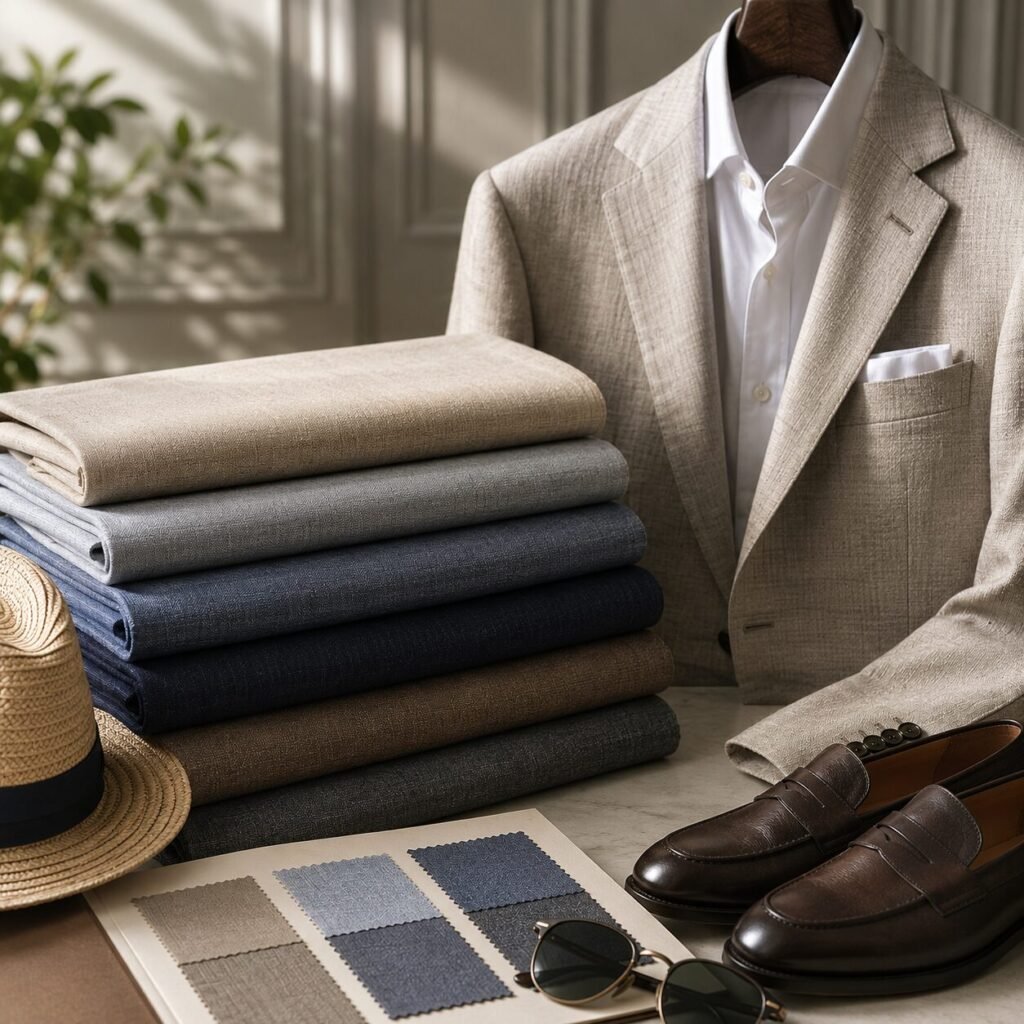
A suit gets the attention. The shirt makes it work. It sits closest to the skin, frames the face, determines how the collar and lapels interact, and provides the visual transition between the jacket and the wearer. Yet when men build a formal wardrobe, the shirt is often treated as an afterthought: white, blue, slim fit, done. That approach misses the point. The best formal shirts for men are not simply shirts that look formal. They are pieces designed with enough precision to make the entire outfit feel more considered. A collar that sits correctly can sharpen the face. A good fabric can give a jacket a cleaner fall. The right cuff can create the small glimpse of shirt that makes tailoring look intentional. Even the difference between crisp white and soft ivory can change the character of an entire suit. In refined menswear, the details are rarely decoration. They are construction. A Formal Shirt Is More Than a White Shirt White remains the most versatile colour in formal shirting for a reason. It works with navy, charcoal, black, brown and almost every traditional suit colour. But formality is not determined by colour alone. A formal shirt is defined by the relationship between fabric, collar, construction, fit and finishing. A crisp cotton shirt with a structured collar can sit naturally beneath a tailored jacket. A softer shirt with a relaxed collar may be excellent for smart-casual dressing but feel underpowered beneath structured tailoring. The difference becomes even more noticeable when the shirt is worn with a tie. The collar needs enough presence to support the knot. The front should remain clean beneath the jacket. The cuffs should appear in proportion to the sleeve. Nothing should bunch unnecessarily around the waist or shoulders. That is why the best formal shirts for men should be considered part of the complete outfit rather than as isolated garments. The Collar Is Where the Outfit Begins Look at a well-dressed man in a suit and your eyes naturally move toward his face. That makes the collar one of the most important details of the shirt. A collar frames the face and also interacts directly with the jacket’s lapel. Different collar shapes create different proportions, which is why there is no universally perfect collar. The Spread Collar The spread collar is one of the most versatile choices for formal dressing. Its wider points create space for a tie knot and complement many contemporary suit silhouettes. It can work particularly well with medium and wider lapels because the proportions feel balanced. The Semi-Spread Collar More restrained than a full spread, the semi-spread is a strong everyday formal option. It works well in professional environments and can transition easily between business and occasion dressing. The Point Collar The narrower, elongated points create a sharper visual line. It can work particularly well with slimmer tailoring and narrower ties. The important consideration is not choosing the “most fashionable” collar. It is choosing one that belongs to the proportions of the rest of the outfit. Why Collar Construction Matters Two shirts can have the same collar shape and still look completely different. The reason is construction. A structured collar can maintain a clean appearance beneath a suit, while softer constructions create a more relaxed roll. For formal dressing, collar construction becomes particularly important because it has to hold its shape around the neck while working with the jacket’s lapels. This is one of those details that may not immediately be obvious to the wearer. But it is visible in the final silhouette. A collar that collapses underneath a jacket can make the entire outfit appear less precise. A collar that maintains its shape creates a cleaner frame around the face. This is why craftsmanship matters even when the difference seems small. White Isn’t the Only Colour Worth Owning The traditional white formal shirt deserves a permanent place in a man’s wardrobe. But stopping there would make the wardrobe unnecessarily predictable. White The ultimate formal foundation. It works with almost every suit and is particularly effective for weddings, formal business occasions and evening dressing. Light Blue A softer alternative to white that remains highly formal. It works exceptionally well with navy, charcoal and grey tailoring and can make business dressing feel less severe without becoming casual. Ivory Ivory introduces warmth and can work beautifully with brown, beige, cream and certain navy tailoring. It is particularly effective when the objective is sophistication rather than strict corporate formality. Subtle Stripes Fine vertical stripes can add dimension without turning the shirt into the focal point. The key word is subtle. A formal shirt should support the tailoring around it rather than compete with the jacket. Soft Pastels Very restrained pink, lavender or muted blue can work for daytime events and contemporary formalwear when the rest of the outfit remains controlled. The colour should complement the suit, not become the reason the outfit exists. The Shirt and Suit Must Speak the Same Language One of the easiest ways to improve formal dressing is to stop thinking about the shirt and suit as separate purchases. They are a single visual composition. Consider a navy suit. A white shirt makes it classic. Light blue makes it slightly softer. Ivory makes it warmer. A fine stripe introduces pattern without disturbing the structure. Now consider charcoal tailoring. White creates strong contrast. Pale blue softens it. A subtle texture can introduce depth while maintaining formality. This becomes even more important when dealing with premium fabrics. A textured wool suit may benefit from a relatively clean shirt. A highly structured worsted suit can support a crisper formal shirt. A relaxed linen jacket generally works better with shirting that shares some of its informality. The principle is simple: Don’t make every element compete for attention. If the suit is the statement, let the shirt provide the foundation. Fabric Is Where Quality Becomes Noticeable You can see a shirt’s colour immediately. You often notice its fabric only after wearing it. And that is
Menswear Wedding Outfit: Dressing With Presence, Not Excess
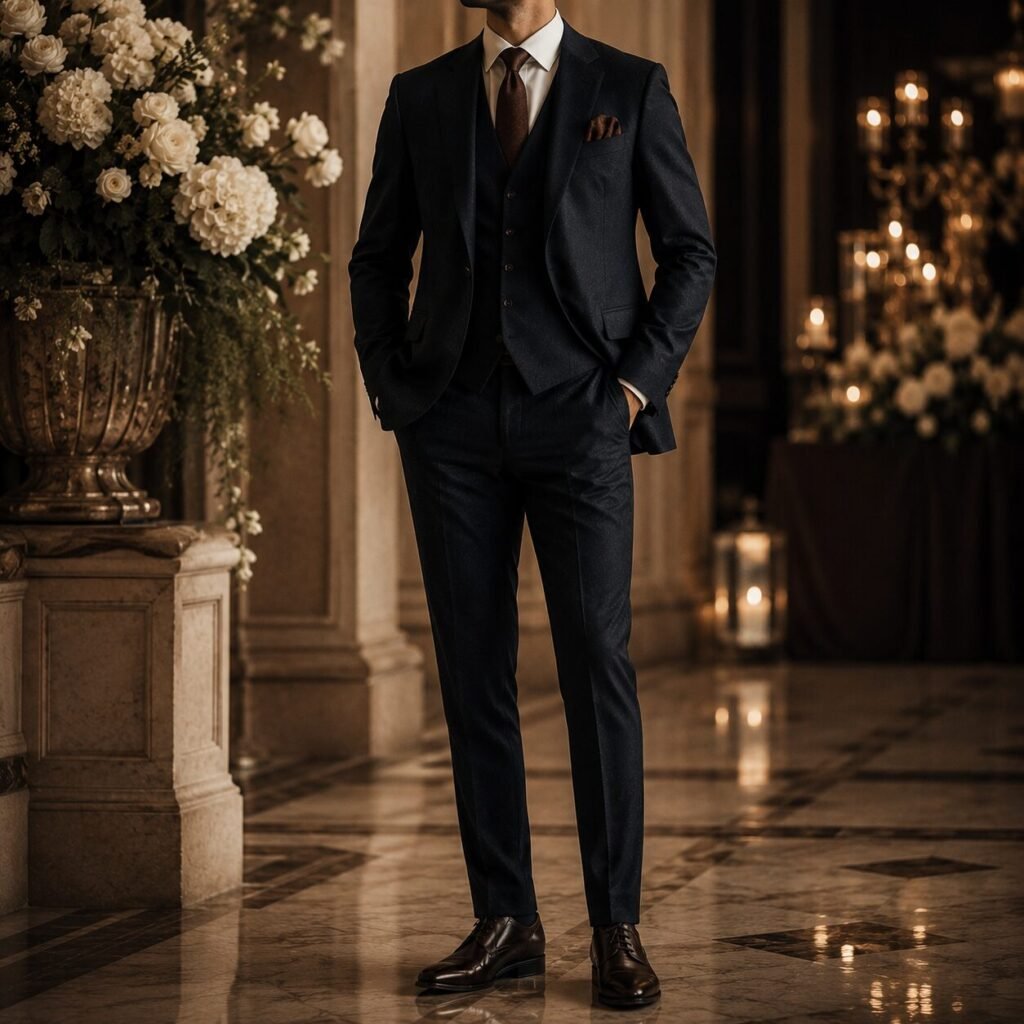
A wedding is one of the few occasions where a man’s clothes are expected to say something before he does. Not necessarily something loud. Not necessarily something extravagant. But something considered. The modern menswear wedding outfit has moved well beyond the predictable formula of a dark suit, white shirt and polished shoes. Indian weddings, in particular, have created a fascinating space where traditional clothing, European tailoring, contemporary silhouettes and luxurious fabrics can exist together. A Bandhgala can be as appropriate as a three-piece suit. A linen suit can look more sophisticated than a heavily embellished outfit when the setting calls for restraint. A double-breasted jacket can bring presence to an evening reception, while a beautifully cut navy suit can remain completely understated. The difference is rarely about how much is being worn. It is about how deliberately it is worn. The strongest wedding dressing understands the occasion, respects the setting and still leaves enough room for the man wearing it to look like himself. The Difference Between Dressing Up and Dressing Well There is an important distinction between dressing formally and dressing well. Formal clothing can be purchased. Good dressing requires judgement. A wedding provides plenty of temptation to overdo things. Rich colours, intricate embroidery, statement accessories and elaborate fabrics can all have their place, but combining too many of them can make an outfit feel designed around the clothing rather than the person. Good tailoring works differently. The shoulder sits naturally. The jacket follows the body without constricting it. The trousers have the right break. The fabric has enough depth to catch light without becoming distracting. Accessories complete the outfit rather than competing with it. This is why fit, proportion and fabric often have a greater visual impact than ornamentation. A beautifully constructed navy suit in fine wool can have more presence than an overly decorated garment simply because everything about it is in balance. That principle is particularly relevant when choosing a menswear wedding outfit for a modern Indian celebration. The Modern Indian Wedding Has Changed Menswear Indian weddings are no longer confined to one venue, one ceremony or one dress code. A wedding may begin with a daytime Haldi, move into an afternoon Mehendi, transition into an evening Sangeet and conclude with a formal reception. Destination weddings introduce another layer, with outdoor ceremonies, resort dinners and formal evening celebrations often taking place within the same weekend. This evolution has expanded men’s wardrobes. The modern Indian wedding wardrobe can include tailored Western suits, three-piece suits, double-breasted tailoring, Bandhgalas, Sherwanis, Indo-Western silhouettes, linen tailoring and velvet evening jackets. The interesting part is not choosing between Indian and Western clothing. It is understanding how each silhouette communicates differently. A groom might choose a Bandhgala for the ceremony and transition into a sharply cut tuxedo for the reception. A wedding guest might wear a lightweight suit for a daytime celebration and a darker, more structured ensemble in the evening. The possibilities are broader, but the principle remains the same: dress for the moment, not simply for the photograph. When the Suit Becomes Part of Indian Wedding Dressing The suit has earned a distinctive place in contemporary Indian weddings because it provides structure without requiring excessive decoration. A well-tailored suit can work particularly well when the wedding calls for formal sophistication rather than traditional ceremonial dress. The three-piece suit, for example, introduces additional formality through the waistcoat. A double-breasted jacket creates a stronger architectural silhouette. A dinner suit can bring restraint to an evening reception. And then there is the Bandhgala. With its closed collar and structured silhouette, the Bandhgala occupies a particularly interesting position between Indian heritage and modern tailoring. The Bandhgala’s evolution into modern formalwear explores how this distinctive silhouette has evolved while retaining its cultural identity. The appeal lies in its ability to feel unmistakably Indian without relying on excessive embellishment. When the Silhouette Says More Than the Embellishment Some wedding outfits are memorable because of their decoration. The best ones are often remembered because of their silhouette. The Two-Piece Suit The two-piece is clean, versatile and understated. It allows the fabric, cut and accessories to establish the personality of the outfit. For a wedding guest, it can be one of the most effective choices because it can be formal without appearing overly ceremonial. The Three-Piece Suit The waistcoat changes the visual balance of the outfit. It creates a stronger central line through the torso and gives the ensemble a more ceremonial character. This makes it particularly effective for grooms, close family members and formal evening celebrations. For a more detailed comparison of the two approaches, see two-piece and three-piece wedding suits. The Double-Breasted Suit The overlapping front and broader visual structure make a double-breasted suit more assertive. It works particularly well for men who appreciate classic tailoring but want something with more presence than a conventional single-breasted jacket. The Bandhgala The closed collar immediately changes the character of the outfit. Rather than using a lapel to frame the shirt and tie, the Bandhgala creates a continuous vertical line around the neck. This gives it a distinctive Indian identity while retaining the precision of structured tailoring. The Tuxedo For a black-tie reception, few garments communicate evening formality as effectively as a properly constructed tuxedo. Its appeal comes from restraint: a clean jacket, refined lapels, formal trousers and carefully selected accessories. The common thread between all of these styles is not extravagance. It is proportion. Fabric Is the Quietest Statement You Can Make If silhouette determines the architecture of a wedding outfit, fabric determines its character. The same suit in different fabrics can look like two completely different garments. Wool creates structure and refined drape. Tropical wool introduces greater breathability for warmer conditions. Linen has a relaxed texture and natural movement. Silk blends can introduce subtle luminosity, while velvet brings depth and richness to evening dressing. For Indian weddings, fabric selection becomes particularly important because climate can change dramatically between venues and seasons. Lightweight wool can be an especially
Types of Suits for Men: A Complete Guide to Modern Suit Styles
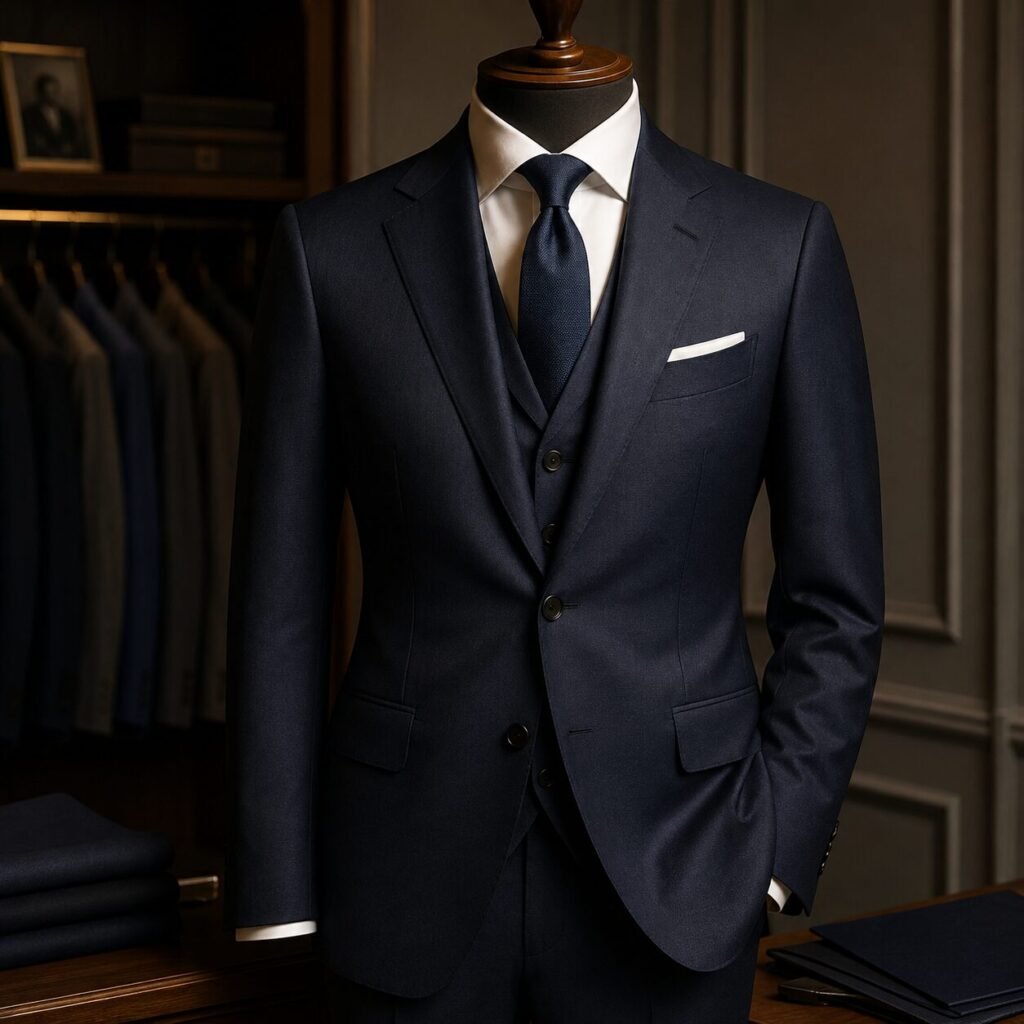
A suit is rarely just a suit. The difference between a two-piece worn to a business meeting, a three-piece chosen for a wedding, a double-breasted jacket for an evening occasion, and a Bandhgala for a formal Indian celebration goes far beyond the number of buttons or layers. Each has its own purpose, proportion, level of formality, and visual language. Understanding the types of suits for men makes it easier to build a wardrobe that works across occasions rather than accumulating suits that all serve the same purpose. The most useful way to approach suit styles is not simply by naming them, but by understanding when they work, how they should fit, what fabrics suit them, and how they can be made relevant to modern Indian menswear. This guide breaks down the major suit styles worth knowing, from foundational two-piece tailoring to three-piece suits, double-breasted styles, tuxedos, Bandhgalas, and seasonal tailoring. What Defines a Suit Style? Before looking at individual styles, it helps to understand what actually changes from one suit to another. A suit can vary according to its number of pieces, jacket construction, button configuration, lapel shape, silhouette, fabric, and intended formality. For example, a two-piece and three-piece suit differ primarily because of the waistcoat. A single-breasted and double-breasted suit differ in their front construction and button arrangement. A tuxedo differs not simply because it is black, but because of details such as satin-faced lapels and trousers designed for black-tie dressing. This distinction matters because the terms are often mixed together. A suit can simultaneously be a three-piece, double-breasted, wool suit with peak lapels. So, rather than thinking of suit styles as completely separate categories, think of them as different elements that can be combined to create a particular look. 1. The Two-Piece Suit The two-piece suit is the foundation of most men’s tailoring wardrobes. It consists of a jacket and matching trousers, without a waistcoat. Its simplicity is precisely what makes it so versatile. A well-cut navy or charcoal two-piece can move from the office to a formal dinner with relatively minor changes in the shirt, tie, and footwear. When to Wear a Two-Piece Suit A two-piece works particularly well for: For a first serious suit, the two-piece is difficult to beat because it offers maximum versatility. The key is choosing a fabric and colour that do not restrict its use. A navy wool suit, for example, can be dressed conservatively for business or styled more expressively for an evening occasion. For men building a formal wardrobe, Shubham Shinde’s suit collection offers a useful starting point for exploring structured tailoring and different silhouettes. 2. The Three-Piece Suit A three-piece suit adds a waistcoat to the traditional jacket-and-trouser combination. That additional layer changes the character of the entire outfit. The waistcoat creates a continuous visual line through the torso and gives the wearer a more formal, composed appearance. It also provides an advantage at events where the jacket may occasionally be removed—the outfit still retains much of its intended structure. When Should You Wear a Three-Piece Suit? Three-piece suits are particularly effective for: Fabric and colour matter enormously here. A dark wool three-piece can appear distinctly formal, while a lighter fabric can create a more relaxed wedding look. If you’re deciding between the two, our detailed comparison of 2-piece and 3-piece wedding suits can help you understand which works better for different wedding settings. 3. The Single-Breasted Suit Among the different types of suits for men, the single-breasted suit is arguably the most versatile. It features one column of buttons and a relatively clean front. Depending on the button stance, lapel width, shoulder construction, and cut, it can range from relaxed to highly formal. The most common configurations include two-button and three-button jackets, with the two-button style remaining particularly adaptable to contemporary wardrobes. Why Single-Breasted Suits Remain Essential Their versatility makes them suitable for almost every man’s wardrobe. A well-tailored single-breasted suit can work for: The important consideration is not simply the number of buttons but the overall proportion of the jacket. A narrow lapel, heavily suppressed waist, and short jacket create a very different impression from a broader lapel, natural shoulder, and longer silhouette. 4. The Double-Breasted Suit A double-breasted suit has overlapping front panels and two parallel columns of buttons. It creates a stronger silhouette than a conventional single-breasted jacket and has historically been associated with confident, formal dressing. Modern double-breasted tailoring, however, does not have to look old-fashioned. Contemporary proportions, cleaner shoulders, and carefully balanced button placement can make the style remarkably sophisticated. When to Wear a Double-Breasted Suit Consider one for: The double-breasted jacket works particularly well when the wearer embraces its structure rather than trying to make it look like a single-breasted suit. The lapels, button stance, and jacket length need to work together. Poor proportions can make the garment look bulky, while precise tailoring gives it authority. 5. The Tuxedo A tuxedo occupies a different category from an ordinary formal suit. Designed for black-tie occasions, the classic tuxedo is distinguished by details such as satin-faced lapels, matching satin detailing on the trousers, and formal evening accessories. The traditional combination includes: A tuxedo is therefore not simply a “fancier black suit.” Its purpose is specifically tied to evening formalwear and black-tie dress codes. Using a standard business suit in place of a tuxedo can make an outfit appear underdressed, particularly at events where black tie is explicitly requested. For a detailed explanation of how formal dress codes differ, authoritative menswear guides such as are useful supplementary references. 6. The Bandhgala Suit Few of the types of suits for men carry as much cultural character as the Bandhgala. Recognised by its closed or stand collar and structured front, the Bandhgala occupies a distinctive position in Indian formalwear. It combines the discipline of tailoring with a silhouette deeply associated with Indian sartorial heritage. It is particularly effective for: The beauty of the modern Bandhgala lies in its restraint. Rather than relying on heavy ornamentation, a
Bandhgala Jacket for Men: Inside the Construction of India’s Most Structured Jacket
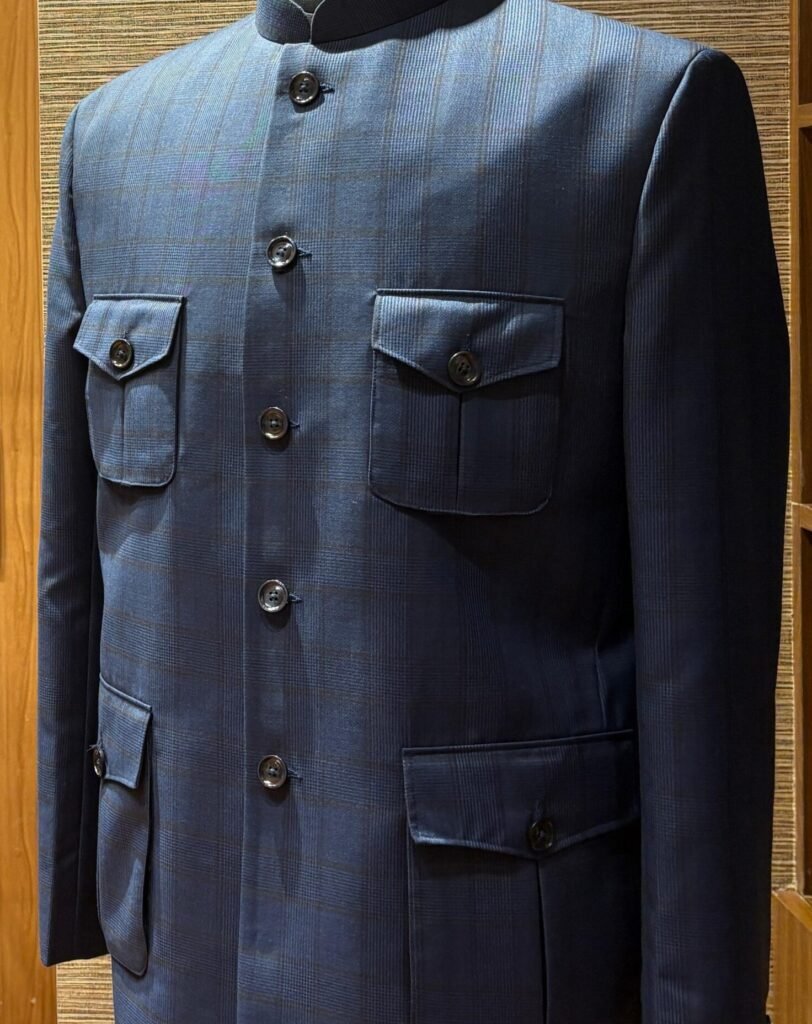
Walk into any room where Indian men are dressed for a serious occasion and you will know a Bandhgala when you see one. There is nothing else quite like it – the closed collar buttoned to the throat, the clean vertical button line, the structured silhouette that carries its own formality without requiring a tie, a lapel, or any borrowed Western context to complete it. It simply stands on its own. What most men do not know is what is happening inside that jacket to make it look and hold the way it does. A bandhgala jacket for men is one of the most technically demanding garments in Indian tailoring. Its defining feature the stand collar requires a precision of construction that a Western jacket’s open lapel does not. Its silhouette depends on an internal structure that is built by hand, layer by layer, before the outer fabric is ever touched. And the difference between a Bandhgala that looks composed from the first hour to the last and one that begins to lose its shape by the evening is almost entirely in how that internal construction was done. This is an inside account of how a Bandhgala jacket is made the materials, the sequence, the hand-work, and the construction decisions that separate a jacket built to last from one that merely looks the part on the hanger. Quick Answer: What Is a Bandhgala Jacket for Men? A Bandhgala jacket for men is a structured formal jacket of Indian origin, defined by a high stand collar – bandh gala translates literally to “closed neck” that buttons completely to the throat, a vertical button placket from collar to hem, and a fitted, suppressed-waist silhouette. It is also known as a Jodhpuri jacket when paired with matching trousers as a complete suit. Unlike a Western jacket, it requires no tie, no dress shirt collar, and no lapel the collar and front placket together create a complete, self-contained formal identity. It is the most structurally demanding jacket in Indian tailoring and, when made correctly, one of the most enduring. Where the Bandhgala Comes From: A Construction History The Bandhgala’s origins sit at the precise intersection of two tailoring traditions. <cite index=”6-1″>It blends the structure of a Western suit jacket with the rich heritage of Indian attire</cite> an inheritance from the period when Indian royal courts absorbed British military tailoring conventions and transformed them into something entirely their own. The result was a jacket that kept the structured chest and suppressed waist of British military dress but replaced the open lapel and collar with India’s own closed-neck tradition. The Jodhpur courts of Rajasthan are most frequently credited with its formal codification hence the alternative name, Jodhpuri suit though similar closed-collar structured jackets existed across Mughal and Maratha court dress in earlier centuries. What makes this history relevant to construction is that the Bandhgala has always been a jacket built for authority and ceremony not for casual adaptation or fast production. <cite index=”6-1″>Its defining feature, the bandh gala, gives the garment its clean lines and stately appearance</cite> and those clean lines depend entirely on the precision of what is built inside. The Anatomy of a Bandhgala: What Is Actually Inside Before discussing the construction sequence, it helps to understand what a properly made Bandhgala jacket actually consists of because this is where most mass-produced and ready-to-wear versions cut corners, and where those corners become visible within the first season of wear. The outer fabric is what you see – the wool, silk blend, velvet, or suiting fabric that gives the jacket its colour and surface character. The canvas interlining is the structural foundation of the jacket – a layer of woven horsehair and cotton canvas stitched to the inside of the front panels that creates the chest shape, holds the button line upright, and gives the jacket its ability to mould to the body over time with wear. In a fused jacket the construction method used in fast production – this layer is replaced with a heat-bonded synthetic interfacing that is cheaper and faster but bubbles, delaminates, and loses its structure with dry cleaning and wear. A properly made Bandhgala uses full canvas or half canvas construction never fused. The collar interlining is specific to the Bandhgala and has no equivalent in Western jacket construction. The stand collar requires its own internal structure – a shaped, stiffened interlining that holds the collar upright, flush against the neck, and completely even in height around the entire circumference. This is the most technically demanding single component in the jacket, and the one that reveals the quality of construction most immediately when it fails. The lining covers the internal construction and allows the jacket to slide on and off easily. In a bespoke Bandhgala, the lining is cut with ease allowances that move with the body rather than pulling against it. The padding and shoulder construction shapes the shoulder line – the canvas roll, the shoulder pad if used, and the sleeve head wadding that fills the top of the sleeve and creates the smooth shoulder-to-sleeve transition visible from the outside. The Construction Sequence: How a Bespoke Bandhgala Is Built Stage 1: Measurement and Pattern Drafting A bespoke Bandhgala begins not with fabric but with measurements and more measurements than a Western jacket requires, because the stand collar adds a critical dimension that an open lapel does not: the neck circumference, the collar height preference, the angle of the neck from the shoulder, and the precise point at which the collar meets the front button placket must all be calculated and drafted into the pattern before cutting. The front button placket of a Bandhgala is a straight, unbroken vertical line from throat to hem. Any deviation in the cut any pull, any curve, any asymmetry is immediately visible because there is no lapel to soften or conceal it. The pattern must be drafted with a precision that leaves no margin for the kind of small errors that disappear
How to Buy a Suit: A Complete Guide to Choosing the Perfect Suit

Introduction Buying a suit is unlike purchasing any other piece of clothing. A well-made suit becomes part of your identity, accompanying you through life’s most significant moments from career milestones and business meetings to weddings, celebrations, and formal occasions. The right suit enhances your confidence, reflects your personality, and leaves a lasting impression long after the event has ended. Yet, despite its importance, many men approach suit shopping with a single question in mind: Which one looks good? While appearance certainly matters, a truly exceptional suit is defined by much more than its colour or style. Fabric, construction, fit, craftsmanship, and purpose all contribute to how a suit looks, feels, and performs over time. One of the most common mistakes is buying a suit without considering where and how often it will be worn. Another is prioritising brand names over tailoring. A perfectly fitted suit in a premium fabric will almost always outperform an expensive designer suit that doesn’t fit correctly. This guide explains how to buy a suit by focusing on the factors that genuinely matter. Whether you’re purchasing your first suit or adding another to an existing wardrobe, understanding these fundamentals will help you make an investment that remains relevant for years rather than seasons. Start with the Occasion Before selecting fabrics, colours, or lapels, ask yourself one simple question: Why are you buying the suit? The answer influences every decision that follows. A suit for daily office wear demands different qualities than one intended for a wedding. Likewise, a destination ceremony in summer requires fabrics that perform differently from those chosen for an evening reception in winter. Business and Professional Wear For professionals, versatility should be the priority. Navy and charcoal remain the most dependable choices because they transition effortlessly between client meetings, presentations, networking events, and formal dinners. A business suit should communicate professionalism without drawing unnecessary attention. Classic colours, refined patterns, and premium wool fabrics achieve exactly that. Weddings Wedding attire offers greater flexibility. The season, venue, dress code, and your role in the celebration all influence the ideal choice. A groom attending a traditional ceremony may prefer a structured Bandhgala or a luxurious three-piece ensemble, while guests often benefit from lighter fabrics and more understated styling. If you’re selecting attire for your wedding day, our guide to choosing the perfect wedding suit explores every aspect of finding a suit that complements both the occasion and your personal style. Cocktail Parties and Evening Events Cocktail attire allows slightly more personality while remaining elegant. Rich navy, deep green, burgundy, or textured fabrics introduce character without compromising sophistication. Summer and Destination Events Outdoor ceremonies and warm climates require breathable fabrics capable of maintaining structure despite higher temperatures. Lightweight wool, tropical wool, and linen blends provide comfort while preserving the sharp silhouette expected from quality tailoring. Buying a suit becomes significantly easier once its intended purpose is clearly defined. Understand the Difference Between Ready-Made, Made-to-Measure and Bespoke Not every suit is created the same way. Understanding the differences between ready-made, made-to-measure, and bespoke tailoring helps explain why two visually similar suits can feel entirely different when worn. Ready-Made Suits Ready-made suits are manufactured using standard sizing intended to fit as many body types as possible. They offer convenience and immediate availability but inevitably involve compromise. Most wearers require alterations to improve sleeve length, trouser break, or waist suppression. While suitable for occasional wear, ready-made garments rarely accommodate individual posture, shoulder balance, or body proportions with complete accuracy. Made-to-Measure Suits Made-to-measure tailoring begins with an existing pattern that is modified using your measurements. This approach provides: For many professionals, made-to-measure represents an excellent balance between customisation and practicality. Bespoke Tailoring Bespoke remains the highest standard of tailoring. Rather than adapting an existing pattern, a completely new pattern is drafted specifically for the individual. Every detail—from shoulder angle and chest balance to sleeve pitch and posture—is considered before a single piece of fabric is cut. The result is a garment that reflects the wearer’s physique, movement, and personal preferences rather than forcing the wearer to adapt to the garment. At Shubham Shinde Atelier, tailoring begins with understanding the individual rather than simply recording measurements. Lifestyle, occasion, fabric preference, and desired silhouette all contribute to creating garments that remain relevant for years rather than following short-lived trends. For those exploring premium tailoring, you can browse our formal suit collection to understand how timeless design and quality craftsmanship come together in modern menswear. Choosing the Right Fabric Fabric determines far more than appearance. It influences breathability, comfort, durability, wrinkle resistance, drape, and even how the suit ages over time. Selecting the appropriate cloth should always depend on climate, frequency of wear, and the intended occasion. Wool: The Benchmark for Tailoring Premium wool continues to set the standard for luxury tailoring. It naturally regulates temperature, resists wrinkles, drapes beautifully, and performs exceptionally across different seasons. Whether worn daily or reserved for formal occasions, wool remains one of the most versatile investments a gentleman can make. For readers interested in understanding wool grades, fibre quality, and why finer wools command greater value, our guide to wool fabrics provides a comprehensive explanation. Tropical Wool Many assume wool is suitable only for winter, but tropical wool proves otherwise. Its open weave improves airflow while retaining the clean structure expected from premium tailoring. This makes tropical wool an excellent choice for professionals and wedding guests attending events during warmer months. If you’re considering lightweight formalwear, our guide to tropical wool tailoring explains why it has become one of the most practical fabrics for modern menswear. Linen Linen offers unmatched breathability and relaxed elegance. Its characteristic texture and natural creasing make it particularly suited to summer weddings, destination celebrations, and resort settings. When tailored correctly, linen combines effortless comfort with understated sophistication. For a deeper understanding of seasonal dressing, continue to our complete guide to linen tailoring, where fabric selection, styling, and maintenance are explored in detail. Wool-Silk Blends For men seeking understated luxury, wool blended with
