
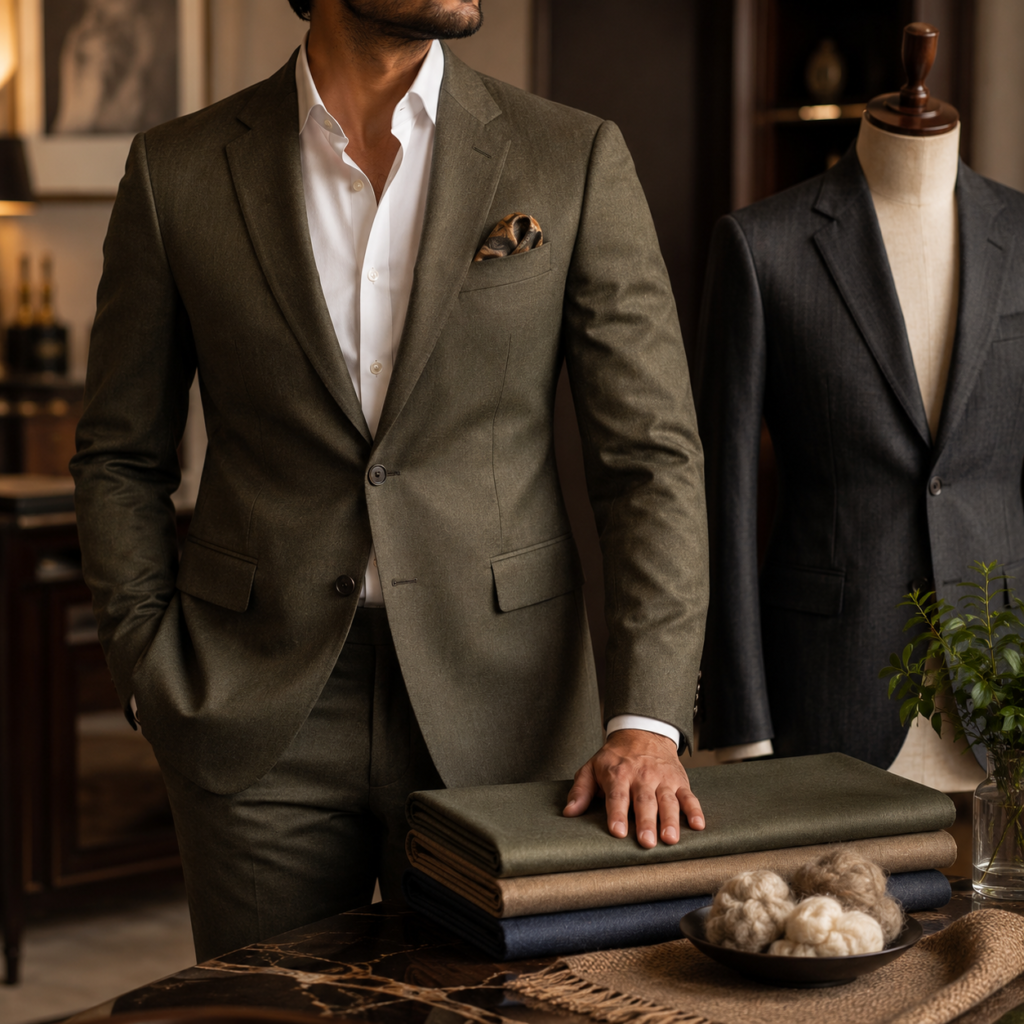
Yes, merino wool and super wool fabric can be worn in India, provided the grade and weave are matched to the specific climate zone. For tropical humid cities such as Mumbai and Chennai, a Super 110s–120s merino in an open tropical weave is the correct choice; for highland cities such as Bengaluru or Shimla, Super 130s–150s in a plain or high-twist weave performs well year-round. Super 200s and heavier flannel constructions are impractical in every Indian climate below 1,500 metres altitude.
Super Wool and Merino Wool in Indian Weather – A Tailor’s Guide
The question arrives at the atelier regularly: can merino wool for Indian weather actually work, or is wool simply a European fabric for European winters? The answer is unambiguous – wool works in India, and in several climate zones it outperforms the alternatives. The condition is precision. The wrong grade in the wrong city is uncomfortable; the right grade in the right weave is among the most refined choices a man can make for formal, professional, or ceremonial dress.
This guide addresses two distinct but related subjects: the specific properties of merino wool that make it suitable for the subcontinent, and the Super wool numbering system as a practical selection tool for Indian buyers. These are not the same thing, and conflating them leads to poor fabric decisions.
India Has Four Climates. Your Wool Needs to Know That.
Wool performs well in India when it is matched to the correct climate zone. The error most buyers make is treating India as a single climate – it is not. The subcontinent spans four distinct suiting-relevant zones, each with different temperature ranges, humidity profiles, and seasonal variation. A fabric appropriate for Bengaluru is not appropriate for Kolkata; a cloth that works in Jaipur in January fails in July.
The table below maps each zone to the wool grades and weaves that serve it best.
| Climate Zone | Cities | Recommended Wool Grade | Recommended Weave | Avoid |
|---|---|---|---|---|
| Tropical Humid | Mumbai, Chennai, Kolkata, Kochi | Super 110s–120s merino | Open tropical weave | Flannel, tweed, heavy twill, S150+ |
| Semi-Arid | Delhi (Oct–Mar), Jaipur, Pune | Super 120s–130s | Plain weave, high-twist | Flannel, S160+ in summer months |
| Highland / Temperate | Bengaluru, Shimla, Ooty, Mussoorie | Super 130s–150s | Plain weave, high-twist | Open tropical weave in winter |
| Arid | Rajasthan interior, Jodhpur, Bikaner | Super 110s–120s (Oct–Feb only) | Tropical or open plain weave | Any wool June–September |
Tropical humid zones (Mumbai, Chennai, Kolkata) present the most demanding conditions: temperatures between 28–38°C combined with relative humidity frequently above 70%. Here, the fibre must manage moisture vapour actively, and the weave must allow air circulation. Super 110s–120s merino in a tropical weave – woven with an open structure at 200–260 g/m² – is the appropriate specification. Heavier constructions trap heat and moisture against the body.
Semi-arid zones (Delhi, Jaipur, Pune) offer more seasonal range. Delhi winters (November through February) are genuine wool weather, permitting Super 120s–130s in a plain weave at 260–300 g/m². The summer months, however, are extreme; wool is not the correct choice from May through August in these cities unless the fabric is exceptionally light and the weave open.
Highland and temperate zones (Bengaluru, Shimla, Ooty) are where wool performs most consistently across the year. Bengaluru’s average temperature range of 15–33°C, with moderate humidity, is almost precisely the operating window of a well-chosen Super 130s–150s plain weave. Shimla and Ooty in cooler months support the upper end of that range.
Arid zones (Rajasthan interior) are wool-viable only in the cooler months – October through February – when temperatures drop to 8–22°C. A Super 110s–120s in a light open weave at 220–250 g/m² is workable for formal occasions. Outside those months, the dry heat exceeds what any wool construction can manage comfortably.
What Is Merino Wool – and Why Does It Behave Differently?
Merino wool is a natural protein fibre sourced from the Merino breed of sheep, distinguished from standard wool by its exceptionally fine fibre diameter. Standard wool fibres measure 30 microns or more in diameter; merino fibres range from approximately 15 to 24 microns, with superfine grades falling between 15 and 18.5 microns. This distinction is not merely technical – it determines whether a fabric feels comfortable against bare skin or causes the prickle response that makes coarser wool unwearable in warm weather.
The relevance for merino wool India buyers is direct: finer fibres bend more readily under contact with the skin, reducing the mechanical irritation that coarser fibres cause. A Super 120s merino suit worn without a shirt layer in a warm boardroom remains comfortable; the same construction in a standard 30-micron wool does not.
Moisture management is the property that most distinguishes merino from alternatives in humid Indian cities. Merino wool is hygroscopic – it absorbs moisture vapour from the microclimate between the fabric and the skin, drawing it into the fibre core before it reaches the surface as liquid sweat. The fibre can absorb up to 35% of its own weight in moisture vapour before it begins to feel damp to the touch. For a man wearing a wool suit India through a wedding reception in Mumbai or a full day of client meetings in Chennai, this property is not a luxury – it is a functional requirement.
Odour resistance follows from the same hygroscopic mechanism. Merino fibres absorb odour molecules along with moisture, preventing the surface accumulation that causes synthetic and cotton fabrics to smell after extended wear. For long event days – corporate presentations, ceremonies, multi-day travel – this extends the effective wear life of a garment between dry cleans.
Temperature regulation is the third distinguishing property. Merino wool is active across a temperature range of approximately 10–30°C, making it viable across Indian seasons in the right grade. The fibre responds to body temperature: in cooler conditions, the crimp structure traps warm air; in warmer conditions, the moisture-wicking action and breathability of the open structure cool the wearer. No synthetic fabric replicates this dual behaviour.
The comparison below sets merino against standard wool for Indian buyers:
| Property | Merino Wool | Standard Wool (30+ microns) |
|---|---|---|
| Fibre diameter | 15–24 microns | 30+ microns |
| Skin comfort | Soft; no prickle | Prickle response in warm weather |
| Moisture absorption | Up to 35% of weight | Lower; surface moisture faster |
| Breathability | High | Moderate |
| Odour resistance | Strong | Moderate |
| Fabric weight range | 180–320 g/m² | 280–450 g/m² |
| Care | Dry clean or gentle hand wash | Dry clean only |
| Price (relative) | Higher | Lower |
The Super Number System – What It Actually Means for Indian Buyers
The Super number – S100, S120, S150, and so on – is a fibre fineness classification, not a quality ranking. It measures the maximum mean fibre diameter of the wool top used to spin the yarn, as defined by the International Wool Textile Organisation (IWTO). Each increment of 10 in the Super number corresponds to a reduction of approximately 0.5 microns in maximum fibre diameter.
The reference points are precise:
| Super Number | Max Fibre Diameter | Best Indian Climate | Durability | Price (relative) |
|---|---|---|---|---|
| Super 100s | 18.75 µm | Tropical humid, semi-arid | High | Moderate |
| Super 110s | 18.25 µm | Tropical humid, semi-arid | High | Moderate–High |
| Super 120s | 17.75 µm | All zones (year-round benchmark) | Good | High |
| Super 130s | 17.25 µm | Semi-arid, highland | Good | High |
| Super 140s | 16.75 µm | Highland, temperate | Moderate | High |
| Super 150s | 16.25 µm | Highland, cooler months | Moderate | Very High |
| Super 160s | 15.75 µm | Highland only | Lower | Very High |
| Super 200s | 13.75 µm | Not recommended for India | Low | Premium |
The Indian sweet spot is Super 110s to Super 130s for year-round formal wear, and Super 140s to Super 150s for highland cities and cooler months. This is not a compromise – it is the technically correct specification for the climate.
The marketing case for Super 200s wool is a different matter. At 13.75 microns, the fibre is extraordinarily fine, and the resulting fabric is genuinely beautiful. It is also fragile: susceptible to pilling, prone to snags from contact with rough surfaces, and structurally unsuited to the humidity and friction of daily wear in any Indian city below 1,500 metres altitude. Mills such as Vitale Barberis Canonico, Loro Piana, Scabal, and Dormeuil all produce Super 200s cloths – and all of them are designed for controlled environments, not the conditions of an Indian summer or monsoon season. Purchasing a Super 200s fabric for a wool suit India is a legitimate choice for a single ceremonial garment worn once in a climate-controlled venue; it is not a practical choice for a working wardrobe.
The persistent marketing association between higher Super numbers and superior quality has no basis in the IWTO standard. The standard measures fineness only. Durability, drape, and handle are functions of fibre length, twist, weave construction, and finishing – not the Super number alone.
Merino Wool vs Super Wool – Are They the Same Thing?
This is the most common point of confusion among Indian buyers, and it is worth addressing directly. “Super wool” and “merino wool” describe two different attributes of a fabric, and they are not interchangeable terms.
Super wool refers to a fineness grade. Any wool – from any breed – can carry a Super number if its fibre diameter meets the IWTO threshold. The Super number tells you how fine the fibre is; it says nothing about the breed, the origin, or the processing method.
Merino wool refers to the fibre source: the Merino sheep, bred specifically for fine, soft wool. Merino is defined by breed, not by fineness grade. A merino fibre is almost always fine – typically between 15 and 24 microns – but it may or may not carry a formal Super number on the fabric label.
A fabric can be both: a Super 120s merino wool is merino fibre that has been graded at Super 120s fineness. This is the most common specification in premium suiting cloth, and it is the benchmark for merino wool suit India buyers seeking year-round formal wear.
Not all Super wool is merino. Some Super-numbered fabrics are woven from Rambouillet, Corriedale, or blended fibres that meet the fineness threshold without being sourced from Merino sheep. These fabrics carry the Super number legitimately but do not share all of merino’s performance properties – particularly the moisture management and temperature regulation characteristics that make merino relevant for Indian conditions.
Not all merino is Super-numbered. Some merino fabric is sold without a formal Super grade, particularly in blended constructions or fabrics marketed for performance rather than formal wear. The absence of a Super number does not indicate inferior fibre; it indicates that the manufacturer has not applied the IWTO classification.
The practical takeaway for Indian buyers: look for both designations together. A fabric labelled “Super 120s merino wool” – sourced from mills with established quality controls – gives you the fineness, the breed-specific performance properties, and the independent grading that together constitute the correct specification for Indian formal wear.
Weave Matters as Much as Fibre – Especially in India
The Super number and the fibre source determine what the fabric is capable of; the weave determines whether that capability is realised in Indian conditions. Two fabrics with identical Super numbers and identical fibre sources will perform very differently depending on how the yarn is constructed and interlaced.
Tropical weave is an open, plain-weave construction with a loose interlacing that maximises air circulation through the cloth. In merino wool, a tropical weave at 200–240 g/m² is the correct specification for Mumbai, Chennai, Kolkata, and Kochi. The open structure allows heat and moisture vapour to escape rather than accumulate, and the light weight reduces the thermal mass of the garment. This is not a compromise construction – tropical weave merino from mills such as Vitale Barberis Canonico or Scabal is among the most technically sophisticated cloth available for warm-weather formal wear.
Plain weave is a denser construction than tropical weave, with a tighter interlacing that produces a more structured handle and a slightly heavier drape. At 260–300 g/m², plain weave merino is the correct specification for Bengaluru, Pune, and Delhi in the cooler months. It provides sufficient body for a well-tailored silhouette while remaining breathable enough for temperatures in the 18–28°C range.
High-twist yarns are spun with additional twist before weaving, which produces a fabric with natural crease resistance and a characteristic dry handle. High-twist merino is particularly well suited to travel and extended event wear – a quality relevant for Indian men who wear formal dress across multi-day occasions such as weddings or corporate conferences. The increased twist also improves durability, making high-twist constructions a sound investment for a working wardrobe.
Flannel, tweed, and heavy twill are constructions to avoid in any Indian climate below 1,500 metres altitude. Flannel’s brushed surface traps heat and moisture; tweed’s coarse, dense structure is designed for cold, damp British conditions that bear no resemblance to any Indian climate zone; heavy twill at 350 g/m² and above creates a thermal mass that is simply incompatible with Indian temperatures. These fabrics have their place – but that place is not the Indian subcontinent.
Care and Longevity – Wool in Indian Conditions
At our atelier, we advise clients that the longevity of a merino wool suit in India is determined less by the quality of the fabric than by the discipline of its care. The fabric itself is resilient; the Indian climate – specifically the combination of humidity, heat, and monsoon moisture – creates storage and maintenance conditions that require consistent attention.
Humidity is wool’s primary enemy when stored incorrectly. After each wear, the suit must be hung on a wide wooden hanger and allowed to air for a minimum of 24 hours before returning to the wardrobe. In Mumbai or Kolkata during the monsoon months, 36–48 hours is more appropriate. Moisture that is sealed into a garment bag before the fabric has fully dried will cause mildew, which permanently damages wool fibre.
Storage must be in breathable cotton or muslin garment bags – never plastic. Plastic traps moisture and prevents the natural off-gassing that wool requires. Silica gel sachets placed inside the wardrobe during monsoon months provide additional humidity control and should be replaced or recharged regularly.
Dry cleaning frequency should be once per season, not after every wear. Over-cleaning degrades merino fibre progressively – the chemical solvents used in dry cleaning break down the fibre’s natural lanolin coating, reducing softness and moisture management over time. Spot cleaning and airing are sufficient for most wear cycles. Reserve dry cleaning for the end of a season or before long-term storage.
Moth risk in India is materially higher than in European climates, where most suiting fabrics are designed and tested. Cedar blocks and cedar hangers are the most effective non-chemical deterrent; camphor is a traditional Indian alternative that provides additional protection. Neither should be placed in direct contact with the fabric. Both should be treated as non-negotiable components of any wool wardrobe in India.
Pressing should be done with steam only, with a pressing cloth between the iron and the fabric. Direct iron contact on merino wool – even at low temperatures – can cause irreversible shine, distortion of the weave, and fibre damage. A quality steam iron held slightly above the surface, or a professional steam press, is the correct method.
What to Ask Your Tailor Before Choosing a Wool Fabric
Selecting the right super wool fabric or merino wool for Indian weather begins with the right questions. The following six questions are not a test of the tailor’s knowledge – they are a framework for a productive conversation that results in a better garment.
- What is the Super number of this cloth? The Super number tells you the fibre fineness and, by extension, the appropriate climate and use case. A tailor who cannot answer this question is working without the information needed to make a correct recommendation.
- Is this merino, or a wool blend? Merino and blended wool fabrics carry different performance profiles. A wool-polyester blend may be more durable and less expensive, but it will not manage moisture or regulate temperature in the same way as pure merino. The distinction matters for Indian conditions.
- What is the weave structure? Tropical, plain, and high-twist weaves perform differently in different climate zones. Knowing the weave allows you to verify that the fabric is appropriate for your city and your use case.
- What is the fabric weight in grams per metre? Fabric weight is the single most practical indicator of how a cloth will feel in Indian heat. For tropical humid cities, 200–260 g/m² is the target range; for highland cities in cooler months, 280–320 g/m² is appropriate.
- Has this cloth been treated for shrinkage? Untreated merino wool can shrink when exposed to moisture and heat – conditions that are unavoidable in India. A shrinkage-treated or machine-washable merino construction provides additional security, particularly for trousers.
- What is the recommended care method? The care method should be specified before the garment is made, not discovered after the first dry clean. Merino wool in particular requires specific handling, and a tailor who works with premium cloth should be able to provide precise care instructions as part of the commission.
Frequently Asked Questions
Can you wear a wool suit in Mumbai’s humidity? Yes – with the correct specification. A Super 110s–120s merino wool in an open tropical weave at 200–240 g/m² is designed precisely for tropical humid conditions. Merino’s moisture-wicking properties allow it to manage the humidity that makes coarser fabrics uncomfortable, and the open weave ensures adequate air circulation. The key is matching the grade and construction to the climate, not avoiding wool altogether.
What is the difference between merino wool and super wool? “Super wool” is a fineness classification based on fibre diameter, as defined by the International Wool Textile Organisation. “Merino wool” refers to the fibre source – the Merino sheep breed. A fabric can be both: Super 120s merino wool is merino fibre graded at Super 120s fineness. Not all Super wool is merino, and not all merino carries a Super number. For Indian formal wear, the most useful specification is a fabric that is both – Super 120s merino is the benchmark.
Which Super number is best for Indian weather? Super 110s to Super 130s is the practical range for most Indian cities and most of the year. Super 120s merino is the year-round benchmark, offering the balance of fineness, durability, and moisture management that Indian conditions require. Super 140s to Super 150s is appropriate for highland cities such as Bengaluru and Shimla in cooler months. Super 160s and above are not recommended for regular wear in any Indian climate zone.
Is merino wool worth the price in India? For formal and ceremonial wear, yes. The moisture management, odour resistance, and temperature regulation properties of merino wool address the specific challenges of the Indian climate more effectively than any alternative suiting fabric at the same weight. A well-maintained merino wool suit India – dry cleaned once per season, stored correctly, and aired after each wear – will retain its performance and appearance for a decade or more. The cost per wear over that period is lower than most alternatives.
How often should you dry clean a merino wool suit in India? Once per season is the correct frequency for a suit in regular rotation. Dry cleaning more frequently degrades the merino fibre’s natural lanolin coating and reduces the fabric’s moisture management properties over time. Between dry cleans, airing the suit for 24–48 hours after each wear, spot cleaning as needed, and steaming to remove creases is sufficient maintenance for most wear cycles.
What is the best wool fabric for a wedding suit in India? For a wedding suit in India, the correct specification depends on the season and city. For a summer or monsoon wedding in a humid city, Super 120s merino in a tropical weave at 220–250 g/m² provides the comfort and elegance the occasion requires. For a winter wedding in a highland or semi-arid city, Super 130s–150s merino in a plain or high-twist weave at 270–300 g/m² is the appropriate choice. In both cases, the best wool for suits in India is merino – specifically a Super-numbered merino from a mill with documented fibre specifications.
