
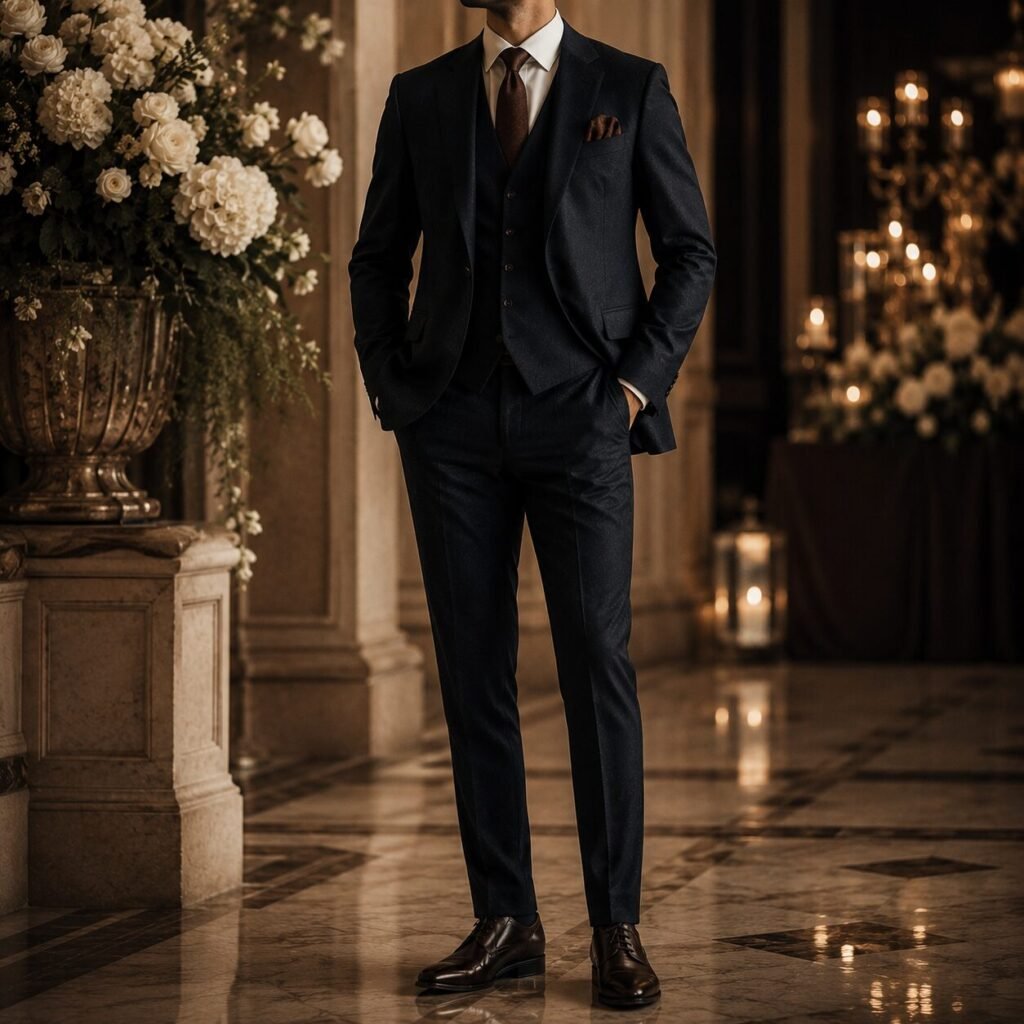
A wedding is one of the few occasions where a man’s clothes are expected to say something before he does.
Not necessarily something loud. Not necessarily something extravagant. But something considered.
The modern menswear wedding outfit has moved well beyond the predictable formula of a dark suit, white shirt and polished shoes. Indian weddings, in particular, have created a fascinating space where traditional clothing, European tailoring, contemporary silhouettes and luxurious fabrics can exist together.
A Bandhgala can be as appropriate as a three-piece suit. A linen suit can look more sophisticated than a heavily embellished outfit when the setting calls for restraint. A double-breasted jacket can bring presence to an evening reception, while a beautifully cut navy suit can remain completely understated.
The difference is rarely about how much is being worn.
It is about how deliberately it is worn.
The strongest wedding dressing understands the occasion, respects the setting and still leaves enough room for the man wearing it to look like himself.
The Difference Between Dressing Up and Dressing Well
There is an important distinction between dressing formally and dressing well.
Formal clothing can be purchased. Good dressing requires judgement.
A wedding provides plenty of temptation to overdo things. Rich colours, intricate embroidery, statement accessories and elaborate fabrics can all have their place, but combining too many of them can make an outfit feel designed around the clothing rather than the person.
Good tailoring works differently.
The shoulder sits naturally. The jacket follows the body without constricting it. The trousers have the right break. The fabric has enough depth to catch light without becoming distracting. Accessories complete the outfit rather than competing with it.
This is why fit, proportion and fabric often have a greater visual impact than ornamentation.
A beautifully constructed navy suit in fine wool can have more presence than an overly decorated garment simply because everything about it is in balance.
That principle is particularly relevant when choosing a menswear wedding outfit for a modern Indian celebration.
The Modern Indian Wedding Has Changed Menswear
Indian weddings are no longer confined to one venue, one ceremony or one dress code.
A wedding may begin with a daytime Haldi, move into an afternoon Mehendi, transition into an evening Sangeet and conclude with a formal reception. Destination weddings introduce another layer, with outdoor ceremonies, resort dinners and formal evening celebrations often taking place within the same weekend.
This evolution has expanded men’s wardrobes.
The modern Indian wedding wardrobe can include tailored Western suits, three-piece suits, double-breasted tailoring, Bandhgalas, Sherwanis, Indo-Western silhouettes, linen tailoring and velvet evening jackets.
The interesting part is not choosing between Indian and Western clothing.
It is understanding how each silhouette communicates differently.
A groom might choose a Bandhgala for the ceremony and transition into a sharply cut tuxedo for the reception. A wedding guest might wear a lightweight suit for a daytime celebration and a darker, more structured ensemble in the evening.
The possibilities are broader, but the principle remains the same: dress for the moment, not simply for the photograph.
When the Suit Becomes Part of Indian Wedding Dressing
The suit has earned a distinctive place in contemporary Indian weddings because it provides structure without requiring excessive decoration.
A well-tailored suit can work particularly well when the wedding calls for formal sophistication rather than traditional ceremonial dress.
The three-piece suit, for example, introduces additional formality through the waistcoat. A double-breasted jacket creates a stronger architectural silhouette. A dinner suit can bring restraint to an evening reception.
And then there is the Bandhgala.
With its closed collar and structured silhouette, the Bandhgala occupies a particularly interesting position between Indian heritage and modern tailoring. The Bandhgala’s evolution into modern formalwear explores how this distinctive silhouette has evolved while retaining its cultural identity.
The appeal lies in its ability to feel unmistakably Indian without relying on excessive embellishment.
When the Silhouette Says More Than the Embellishment
Some wedding outfits are memorable because of their decoration.
The best ones are often remembered because of their silhouette.
The Two-Piece Suit
The two-piece is clean, versatile and understated. It allows the fabric, cut and accessories to establish the personality of the outfit.
For a wedding guest, it can be one of the most effective choices because it can be formal without appearing overly ceremonial.
The Three-Piece Suit
The waistcoat changes the visual balance of the outfit.
It creates a stronger central line through the torso and gives the ensemble a more ceremonial character. This makes it particularly effective for grooms, close family members and formal evening celebrations.
For a more detailed comparison of the two approaches, see two-piece and three-piece wedding suits.
The Double-Breasted Suit
The overlapping front and broader visual structure make a double-breasted suit more assertive.
It works particularly well for men who appreciate classic tailoring but want something with more presence than a conventional single-breasted jacket.
The Bandhgala
The closed collar immediately changes the character of the outfit.
Rather than using a lapel to frame the shirt and tie, the Bandhgala creates a continuous vertical line around the neck. This gives it a distinctive Indian identity while retaining the precision of structured tailoring.
The Tuxedo
For a black-tie reception, few garments communicate evening formality as effectively as a properly constructed tuxedo.
Its appeal comes from restraint: a clean jacket, refined lapels, formal trousers and carefully selected accessories.
The common thread between all of these styles is not extravagance.
It is proportion.
Fabric Is the Quietest Statement You Can Make
If silhouette determines the architecture of a wedding outfit, fabric determines its character.
The same suit in different fabrics can look like two completely different garments.
Wool creates structure and refined drape. Tropical wool introduces greater breathability for warmer conditions. Linen has a relaxed texture and natural movement. Silk blends can introduce subtle luminosity, while velvet brings depth and richness to evening dressing.
For Indian weddings, fabric selection becomes particularly important because climate can change dramatically between venues and seasons.
Lightweight wool can be an especially useful option for warm-weather tailoring. The Woolmark Company notes that Merino wool has natural breathability and temperature-regulating properties, while its fibre structure also contributes to wrinkle recovery. Wool fibre properties and performance provides further technical information.
Fine wool is also not limited to cold-weather dressing. Vitale Barberis Canonico describes wool as breathable, naturally crease-resistant and capable of helping with thermoregulation, which helps explain why carefully selected wool cloth can work across seasons. Explore fine wool suit fabrics.
That makes the choice of fabric more than an aesthetic decision.
It becomes a question of comfort, performance and appearance working together.
For a deeper comparison of warm-weather tailoring, wool, linen and cotton for summer suiting looks at how these fabrics behave in Indian conditions.
And for a more structured approach to lightweight tailoring, tropical wool for warm-weather tailoring explores why tropical wool works particularly well when maintaining structure matters.
For relaxed summer celebrations, linen suits for men offers another direction.
Colour Doesn’t Have to Shout
Wedding dressing often creates the temptation to choose the brightest or richest colour available.
But sophistication doesn’t necessarily come from intensity.
It can come from depth.
Navy has a quiet authority that works beautifully for formal celebrations. Midnight blue can look particularly rich under evening lighting. Charcoal brings seriousness and refinement. Ivory and beige work naturally for daytime weddings. Deep green and burgundy offer personality without becoming theatrical.
The fabric itself also changes the way colour behaves.
A matte wool in deep navy feels different from a silk-blend navy with a subtle sheen. Ivory linen communicates something completely different from ivory velvet.
This is why colour should never be considered independently from fabric and occasion.
A successful menswear wedding outfit is usually the result of these elements working together rather than one element trying to dominate.
The Groom Should Look Like Himself—Only More Considered
The groom has more freedom than almost anyone else at the wedding.
He can be more expressive, more formal and more experimental.
But there is a trap.
Wedding culture can encourage men to dress as though they are playing a character rather than dressing as themselves.
A man who normally prefers clean, minimal tailoring does not necessarily need heavy embroidery simply because it is his wedding. Someone who feels most confident in Western tailoring does not need to abandon it simply because the ceremony is Indian.
The wedding outfit should elevate the groom’s identity, not replace it.
This is where bespoke and made-to-measure tailoring can become particularly valuable.
At Shubham Shinde Atelier, the process can begin with the individual—the proportions, preferred silhouette, occasion, fabric and personal style—rather than forcing the wearer into a predetermined wedding template.
That distinction matters.
A wedding garment should feel special without feeling unfamiliar.
The Guest Has a Different Responsibility
Wedding guests have a different sartorial role.
The objective is to look exceptional while understanding that the wedding is not your personal runway.
That does not mean dressing conservatively all the time.
It means understanding where to stop.
A guest can introduce a distinctive fabric, an interesting colour, a three-piece silhouette or a carefully chosen accessory. What matters is that the outfit remains appropriate to the event and does not compete unnecessarily with the groom.
For daytime celebrations, lighter tailoring and softer colours can work beautifully.
For evening functions, deeper colours and more structured silhouettes generally create greater visual weight.
The most sophisticated guest is often the one who looks exceptionally well dressed without appearing to have tried to outdress everyone else.
The Details That Make the Outfit Personal
Once the foundation is right, personalisation can happen through details.
A wider peak lapel can make a suit feel more commanding. A softer notch lapel can make it more versatile. A distinctive button material can subtly change the character of a jacket.
The same applies to pocket squares, cufflinks, watches, ties, bow ties, dress shoes, shirt collars and boutonnières.
The key is editing.
If the suit already has a strong fabric and distinctive silhouette, the accessories should usually become quieter.
If the suit is deliberately understated, accessories can introduce small moments of personality.
Luxury rarely requires more.
Often, it requires better choices.
The Indian Wedding Wardrobe Doesn’t Need to Choose Between East and West
Perhaps the most interesting development in Indian menswear is the increasing comfort with combining traditions.
A man can wear a Bandhgala with tailored trousers. A Western suit can be made in colours traditionally associated with Indian celebrations. A structured jacket can use a richly textured Indian fabric. A three-piece suit can be styled with subtle traditional accessories.
The result doesn’t have to be classified as either Indianwear or Westernwear.
It can simply be modern Indian tailoring.
That distinction is important because contemporary menswear does not have to reject heritage in order to feel modern.
It can reinterpret it.
The Bandhgala is perhaps the clearest example: its heritage remains visible through the collar and silhouette, while contemporary construction, premium cloth and cleaner proportions give it a distinctly modern character.
The Outfit Should Survive the Photograph
Wedding clothing has one unusual characteristic: it is documented relentlessly.
But an outfit should not be designed solely for photographs.
It should work when you’re standing at the ceremony, sitting through dinner, moving between venues, greeting guests and spending several hours on the dance floor.
This is where construction and fabric become practical considerations rather than abstract markers of luxury.
The jacket should maintain its shape. The trousers should remain comfortable. The fabric should perform appropriately for the temperature. The fit should allow movement without losing its silhouette.
This is particularly important for Indian weddings, where celebrations can easily extend for several hours.
A beautiful outfit that becomes uncomfortable after thirty minutes is not particularly successful tailoring.
What Makes a Wedding Outfit Worth Keeping?
A wedding outfit becomes a genuine investment when it can exist beyond the wedding itself.
A navy suit can return for business dinners.
A charcoal three-piece can become evening tailoring.
A well-cut Bandhgala can work for formal cultural occasions.
A linen suit can move from a wedding to a destination dinner.
This is where timeless design becomes more valuable than a trend.
The objective is not to create something that looks spectacular for one photograph and dated two years later.
It is to create something that acquires meaning with time.
Quality wool, for example, can offer a combination of resilience, breathability and natural wrinkle recovery that makes it particularly useful for repeated wear. Learn more about wool’s natural performance.
Good construction, appropriate fabric and precise fit therefore become part of the value proposition.
The Best Wedding Outfit Is the One That Still Feels Like You
The modern menswear wedding outfit does not need to follow a single formula.
It can be a three-piece suit in deep navy. A lightweight linen ensemble in ivory. A sharply cut double-breasted jacket. A Bandhgala with a restrained silhouette. Or a tuxedo designed specifically for an evening reception.
What connects these choices is not the garment itself.
It is the intention behind it.
The best wedding dressing finds the balance between occasion and individuality, tradition and modernity, presence and restraint.
At Shubham Shinde Atelier, that philosophy comes through in the emphasis on proportion, fabric integrity, structured silhouettes and considered craftsmanship. The goal is not simply to create a garment for a wedding day, but tailoring that continues to feel relevant long after the celebration has ended.
Because the most memorable wedding outfit is rarely the one that asks to be noticed.
It is the one that makes the man wearing it impossible to overlook.
Frequently Asked Questions
What is the best menswear wedding outfit for a modern Indian wedding?
There is no single answer. A three-piece suit, Bandhgala, double-breasted suit or refined two-piece can all work depending on the wedding’s dress code, venue, season and the wearer’s role.
Can a suit be worn to an Indian wedding?
Absolutely. Contemporary Indian weddings increasingly accommodate Western tailoring alongside traditional Indianwear. The key is choosing a silhouette, fabric and colour appropriate to the ceremony and setting.
Is a three-piece suit suitable for a wedding?
Yes. A three-piece suit adds formality and works particularly well for grooms, close family members and evening celebrations.
What fabrics work best for wedding outfits in India?
The right fabric depends on the season and venue. Lightweight wool and tropical wool are useful for warmer conditions, while linen works well for relaxed daytime and destination weddings. Heavier wool, velvet and richer blends can be appropriate for cooler evening celebrations.
Should a groom wear a Bandhgala or a suit?
Both can work. A Bandhgala offers a stronger connection to Indian formalwear, while a Western suit provides a more globally oriented tailored silhouette. The better choice is the one that reflects the groom’s personal style and the character of the wedding.
How can a wedding outfit look luxurious without being overdone?
Prioritise fit, fabric, construction and proportion. A beautifully tailored garment in an exceptional fabric usually creates a more refined impression than excessive embellishment or too many accessories.
