
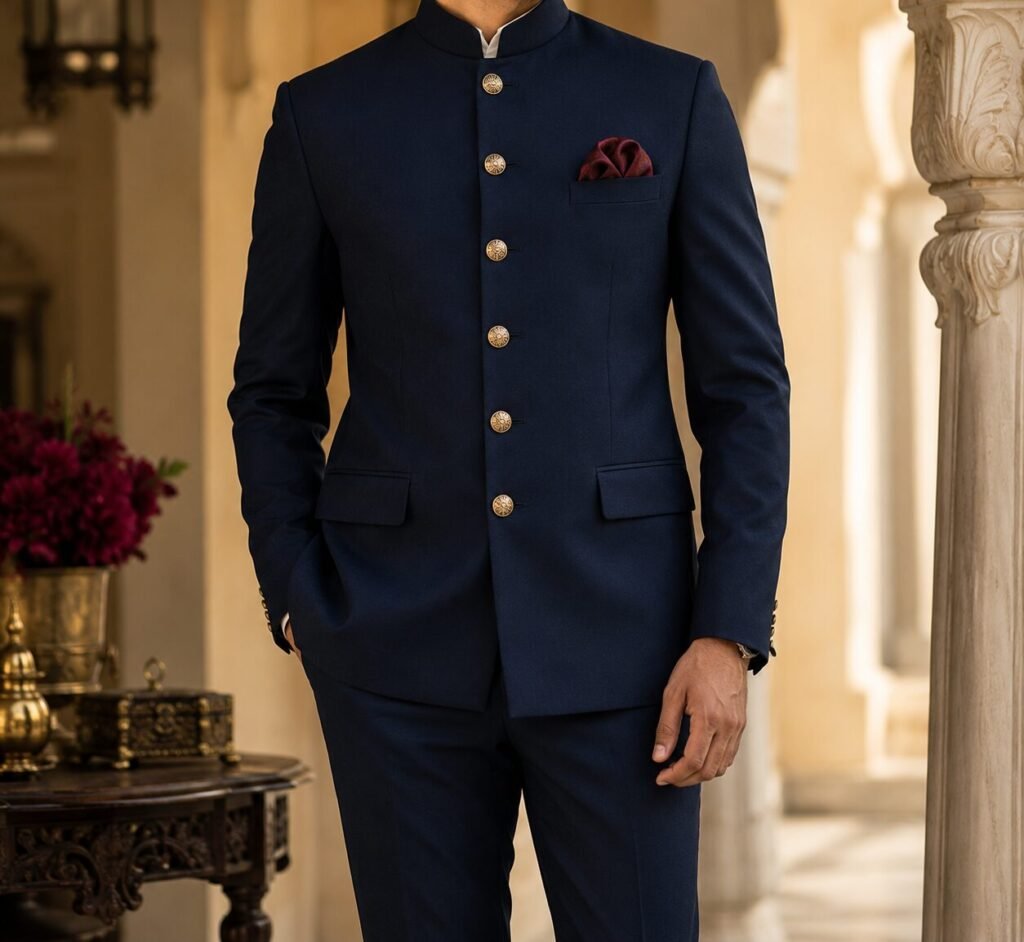
A bandhgala jodhpuri suit is a complete two-piece Indian formal ensemble comprising a structured, lapel-free coat with a closed stand collar (the bandhgala) and a pair of matching tailored trousers – together forming what is widely regarded as India’s most authoritative ethnic silhouette for men. It is worn at weddings, formal receptions, diplomatic engagements, and high-ceremony festive occasions. The key distinction from a plain bandhgala jacket is the matching trouser set: the jodhpuri element transforms a standalone jacket into a coordinated suit of equal formality to a Western black-tie ensemble. In bespoke form, it is constructed with a floating canvas chest, hand-sewn buttonholes, and a precisely rolled collar – details that separate a garment of genuine craft from a mass-produced approximation.
The Bandhgala Jodhpuri Suit: A Complete Guide to India’s Most Commanding Ethnic Silhouette
Few garments in the canon of men’s formal dress carry the structural authority of the bandhgala jodhpuri suit. Rooted in the princely courts of Rajasthan, refined through a century of tailoring evolution, and now worn at the highest levels of Indian ceremony and diplomacy, it occupies a position in Indian menswear that has no direct Western equivalent. It is neither a suit in the European sense nor a traditional sherwani – it is something more precise: a garment that communicates cultural identity through disciplined construction rather than decorative excess.
This guide covers every dimension of the bandhgala jodhpuri suit – its history, anatomy, fabric options, fit requirements, occasion styling, current design directions, and long-term care – written from the perspective of practitioners who cut and construct these garments by hand.
What Is a Bandhgala Jodhpuri Suit?
A bandhgala jodhpuri suit is a structured two-piece Indian formal suit consisting of a closed-collar coat – the bandhgala – paired with matching tailored trousers cut from the same cloth. The term combines two distinct garment identifiers: bandhgala (from Hindi, meaning “closed neck”) refers to the stand collar that fastens at the throat without lapels, and jodhpuri denotes the complete suit format – coat and trouser – that originated in the royal court of Jodhpur in Rajasthan.
The distinction between a bandhgala jacket and a bandhgala jodhpuri suit is precise and meaningful. A bandhgala jacket is a standalone upper garment, typically worn over churidars, trousers, or kurta-pyjama. A bandhgala jodhpuri suit is a coordinated two-piece ensemble in which the coat and trouser are cut from identical fabric, creating a unified formal silhouette of the highest ceremonial register.
Comparison: Bandhgala Jacket vs Bandhgala Jodhpuri Suit
| Feature | Bandhgala Jacket | Bandhgala Jodhpuri Suit |
|---|---|---|
| Garment components | Jacket only | Structured coat + matching trousers |
| Collar style | Closed stand collar | Closed stand collar |
| Occasions | Semi-formal to formal; festive | Formal to black-tie; weddings; diplomatic |
| Formality level | High | Very high – equivalent to Western black tie |
| Styling flexibility | Worn over churidars, trousers, kurta | Worn as a complete coordinated set |
| Fabric coordination | Jacket fabric independent of trouser | Coat and trouser cut from identical cloth |
| Construction standard | Varies; often lighter | Typically full-canvas or half-canvas |
The jodhpuri suit for men thus represents the most formal expression of the bandhgala silhouette – a complete garment system rather than a separates-based ensemble.
The History and Royal Origins of the Jodhpuri Suit
The bandhgala jodhpuri suit did not emerge from a single moment of invention. Its lineage runs from the fitted, high-collared court garments of the Mughal era – the jama and angrakha of the 16th century – through the military dress of Rajput nobility, and into the tailoring workshops of late 19th-century Jodhpur, where Indian court tradition met British suiting conventions.
The Mughal courts under Akbar formalized a culture of structured, close-fitting court dress with high-standing collars and precise front closures. These garments, worn by nobles and military commanders, established the aesthetic vocabulary that would later define the bandhgala: authority expressed through restraint, the collar as a mark of rank. As documented by historians of Indian dress – and traced in detail in Indian Railways, Bandhgala Uniforms, the Mughal Origins – the closed-neck silhouette was already a signifier of formal power long before it encountered European tailoring.
The Jodhpuri suit connection crystallised in the late 19th century. The Jodhpur royal family, renowned for their horsemanship and military bearing, adapted the fitted court jacket for riding and polo – practical garments that required structured shoulders, a suppressed waist, and freedom of movement. The matching trouser, cut with a slight flare at the thigh for equestrian use, became the precursor to what we now call the jodhpuri trouser. The ensemble’s association with Maharaja Pratap Singh of Jodhpur – who is said to have had a version of the garment tailored during his attendance at Queen Victoria’s Diamond Jubilee celebrations in 1897 – helped introduce the silhouette to an international audience familiar with Savile Row conventions.
The result was a garment that synthesised two great tailoring traditions: the structural precision of British suiting and the cultural authority of Indian court dress. The bandhgala collar – closed, standing, fastened at the throat – became the defining element that distinguished this hybrid form from both a Western suit and a traditional Indian coat.
Through the 20th century, the bandhgala jodhpuri suit evolved from royal court dress into the formal uniform of Indian statesmen, diplomats, and cultural figures. Jawaharlal Nehru’s adoption of the bandhgala jacket as his signature garment brought the closed-collar silhouette into the vocabulary of modern Indian public life. The jodhpuri suit format – the complete two-piece – retained its association with the highest ceremonial occasions: weddings, state functions, and formal receptions.
At Shubham Shinde Atelier, the craft lineage that informs every bandhgala jodhpuri suit we construct draws directly from this history. The closed collar is not decorative – it is structural, requiring precise grain alignment and internal support to hold its form across a full day of wear. Understanding where the garment came from is inseparable from understanding how it must be built.
Anatomy of a Bandhgala Jodhpuri Suit – What to Look For
A bandhgala jodhpuri suit is a garment of considerable technical complexity. Each component contributes to the overall silhouette, and the quality of construction at each point determines whether the suit reads as a masterwork or a compromise.
The Bandhgala Collar – Why the Closed Mandarin Collar Defines the Silhouette
The collar is the defining element of the bandhgala suit. It stands between 3.5 cm and 5 cm in height, fastens at the centre front with a single button or hook-and-bar, and frames the face and neck without the outward distraction of lapels. In a well-constructed bandhgala, the collar rolls gently from the back of the neck to the front closure – a quality tailors call collar roll – rather than standing rigidly upright. This roll is achieved through the precise application of canvas interfacing and hand-stitching, not through fusing or stiffening agents.
The collar must sit flat against the neck without gapping at the sides or pulling at the front. A collar that gaps indicates either an incorrect neck measurement or a failure to account for the wearer’s neck pitch during the pattern-making stage. In our experience crafting bandhgala collars, the difference between a collar that commands and one that merely covers comes down to three millimetres of adjustment and the direction of the grain cut.
The Jodhpuri Coat – Structured Chest, Single or Double-Breasted, Button Count
The coat of a bandhgala jodhpuri suit is typically single-breasted, fastening with four to six buttons along the centre front. Double-breasted versions exist and carry a more formal, ceremonial register. The front is lapel-free – a clean, uninterrupted line from collar to hem – and the hemline falls at the mid-hip, slightly longer than a standard Western suit jacket.
The chest is structured through canvas construction: a layer of horsehair or wool canvas is hand-stitched to the front panel, creating a chest that holds its shape through the wearer’s own body heat rather than through adhesive fusing. The shoulders are defined but not padded to excess – the jodhpuri coat reads as military in its precision, not theatrical in its volume.
Sleeve buttons – typically three or four – are functional in a bespoke garment, with working buttonholes that open and close. The sleeve pitch, the angle at which the sleeve is set into the armhole, is one of the most technically demanding aspects of the coat: an incorrect pitch causes the sleeve to twist or pull, distorting the entire front of the garment.
The Trouser – Matching Fabric, Straight Cut vs Tapered, Waistband Details
The tailored trousers of a bandhgala jodhpuri suit are cut from the same cloth as the coat, ensuring tonal and textural unity across the ensemble. The cut is typically straight or very slightly tapered – a silhouette that reads as formal without the fashion-forward narrowness of a slim-cut trouser. The break at the shoe is minimal: a half-break or no-break, allowing the trouser hem to sit cleanly above the shoe without pooling.
The waistband is typically extended with a hook-and-bar closure, and the trouser is cut with a medium rise – high enough to sit comfortably beneath the coat hem, low enough to allow ease of movement. Side adjusters or a curtain waistband are preferable to belt loops in a formal jodhpuri suit, as they preserve the clean line of the trouser front.
Lining and Construction – Canvas vs Fused, Hand-Stitching Markers, Bespoke vs RTW Tells
The lining of a bandhgala jodhpuri suit serves both functional and aesthetic purposes. A full lining in silk or Bemberg (cupro) allows the coat to slip on and off easily, protects the outer fabric from body heat and perspiration, and adds a layer of structure. In a bespoke garment, the lining is hand-stitched at the hem and sleeve, allowing it to move independently of the outer shell – a detail that prevents the coat from pulling or distorting during wear.
The most reliable indicator of construction quality is the chest. Press the front of the coat between your fingers: a fused chest feels stiff and uniform, with no give; a canvas chest has a subtle, responsive softness – it yields slightly and springs back. Over time, a fused chest delaminates with dry cleaning and heat; a canvas chest improves with wear, moulding to the wearer’s body.
What Separates a Bespoke Bandhgala Jodhpuri Suit from a Mass-Produced One
Five craft markers distinguish a genuinely bespoke bandhgala jodhpuri suit from a ready-to-wear approximation:
- Floating canvas chest – hand-stitched horsehair or wool canvas that moulds to the body over time, rather than a fused interlining that stiffens and delaminates.
- Hand-sewn buttonholes – worked by hand with a gimp thread, with a clean keyhole or straight eye; machine buttonholes have a visible uniformity and a locked stitch that lacks the subtle variation of hand-work.
- Pick-stitching – a row of small, evenly spaced hand stitches along the collar edge, lapel (where applicable), and pocket flaps, visible as a fine decorative line that also serves to hold the facing in place.
- Fabric grain alignment – in a bespoke coat, the grain of the outer fabric runs perfectly vertical at the centre front and horizontal at the chest; misaligned grain causes the coat to twist or pull, a common tell in mass-produced garments.
- Collar roll – the collar transitions from the back neck to the front closure with a gentle, natural roll, achieved through hand-stitching and canvas work rather than stiffening; a rigid, upright collar that does not roll is a sign of fused construction.
Fabric Guide – Choosing the Right Material for Your Bandhgala Jodhpuri Suit
Fabric selection is the first and most consequential decision in commissioning a bandhgala jodhpuri suit. The right cloth determines not only the garment’s appearance but its comfort across a full day of ceremony, its drape under a coat’s structured construction, and its longevity over years of careful wear.
Wool and Tropical Wool – Year-Round Wearability in the Indian Climate
Wool is the foundation fabric of structured tailoring, and tropical wool – a lightweight, open-weave worsted – is the most practical choice for the Indian climate. Woven from fine merino fibres at weights between 180 and 240 gsm, tropical wool breathes in heat, resists creasing through a full day of wear, and holds a pressed crease in the trouser with minimal maintenance. It is the fabric of choice for weddings held in air-conditioned venues, corporate settings, and year-round formal occasions.
Super 100s to Super 130s wool provides the ideal balance of fineness and durability for a jodhpuri suit. Finer counts – Super 150s and above – are softer but less resilient, prone to pilling and distortion under the stress of a structured coat’s canvas.
Silk and Silk Blends – For Weddings and Ceremonial Occasions
Pure silk and silk-wool blends carry a natural sheen and a fluid drape that reads as inherently ceremonial. For a jodhpuri suit for a wedding – particularly a baraat or reception – silk adds a luminosity that catches light without the heaviness of brocade. Silk-wool blends (typically 50/50 or 60/40) offer the sheen of silk with the structure retention of wool, making them more practical for a full-day event.
Raw silk and dupioni silk have a more textured, matte surface and are appropriate for daytime weddings and festive occasions where a subtler sheen is preferred. Pure silk requires more careful construction – it is prone to slipping during cutting and must be handled with precision at the collar and button-stand.
Linen and Cotton – Summer and Daytime Events
Linen and cotton bandhgala jodhpuri suits are appropriate for daytime events, outdoor summer weddings, and festive occasions in warm weather. Linen breathes exceptionally well but creases readily – a characteristic that reads as relaxed rather than formal, making it better suited to sangeet evenings or daytime functions than to high-ceremony receptions. Cotton-linen blends reduce the creasing tendency while retaining breathability.
For a structured jodhpuri coat in linen or cotton, the canvas must be adapted – a lighter, more flexible canvas is required to prevent the coat from feeling stiff against a soft outer fabric.
Velvet and Brocade – Festive and Evening Wear
Velvet and brocade are the fabrics of winter weddings, evening receptions, and high-ceremony festive occasions. Velvet – particularly silk velvet or cotton velvet – absorbs light rather than reflecting it, creating a depth of colour that reads as deeply formal. Navy velvet, bottle green velvet, and burgundy velvet are the most versatile choices for a jodhpuri bandhgala for groom use at winter weddings.
Brocade, with its woven metallic or tonal patterns, carries the visual weight of traditional Indian ceremony. It is best used for the coat alone, with a plain matching trouser in a complementary fabric, to avoid the ensemble reading as overly heavy.
Fabric Selection Table
| Fabric | Best Season | Best Occasion | Texture / Drape | Care Level |
|---|---|---|---|---|
| Tropical wool | Year-round | Corporate, formal receptions, weddings | Smooth, structured, minimal sheen | Dry clean; steam press |
| Merino / Super 100s–130s wool | Oct–Mar | Weddings, diplomatic events | Fine, fluid, slight sheen | Dry clean; cedar storage |
| Silk-wool blend | Oct–Mar | Baraat, reception, festive | Lustrous, semi-structured | Dry clean only |
| Pure silk | Oct–Mar | Ceremonial, evening reception | Fluid, high sheen | Dry clean; handle with care |
| Linen / cotton-linen | Apr–Sep | Daytime weddings, sangeet, Eid | Textured, breathable, casual drape | Hand wash or gentle dry clean |
| Cotton | Apr–Sep | Festive, Navratri, daytime events | Matte, soft, relaxed | Machine wash (cold); steam |
| Velvet | Nov–Feb | Evening receptions, winter weddings | Deep, light-absorbing, luxurious | Dry clean; brush with grain |
| Brocade | Oct–Mar | Baraat, high-ceremony events | Stiff, textured, ornate | Dry clean; store flat |
Occasions and How to Style a Bandhgala Jodhpuri Suit
The bandhgala jodhpuri suit is a garment of considered occasion. Its formality is inherent – it does not require accessories to announce itself – but the right styling choices elevate it from correct to commanding.
Wedding and Baraat – Colour Choices, Embellishment Level, Accessories
For the baraat and wedding ceremony, the jodhpuri suit for a groom should read as the most considered garment in the room. Ivory, off-white, and champagne remain the most traditional choices for the groom’s bandhgala jodhpuri suit, communicating ceremony without competing with the bridal palette. Deep jewel tones – emerald, sapphire, burgundy – are equally appropriate and offer a more distinctive presence.
Embellishment at the wedding level is restrained: tonal embroidery at the collar, cuffs, and pocket edges; subtle zardozi work on the button-stand; or a contrast piping detail in a complementary colour. Heavy all-over embroidery reads as sherwani territory and undermines the structural authority of the jodhpuri silhouette.
Accessories: mojris (traditional embroidered shoes) in leather or velvet; a pocket square in silk or linen, folded flat or in a simple puff; a brooch or sarpech-inspired pin at the collar. No tie, no cravat – the closed collar is complete in itself.
Sangeet and Cocktail Evenings – Lighter Fabrics, Bolder Colours, Less Embellishment
The sangeet and cocktail reception call for a bandhgala suit that is festive without being ceremonial. A silk-blend or linen jodhpuri suit in a bold colour – cobalt, forest green, terracotta, or a deep rose – reads as confident and occasion-appropriate. Embellishment should be minimal: a contrast collar lining, a printed pocket square, or a statement button in horn or resin.
The trouser can be cut slightly slimmer for an evening event, and the shoe can shift from mojri to a leather loafer or Chelsea boot in a complementary tone.
Corporate and Diplomatic Settings – Navy, Charcoal, Ivory; Minimal Embellishment; Leather Oxford Pairing
The bandhgala jodhpuri suit is increasingly present in corporate boardrooms and diplomatic settings as a formal alternative to the Western business suit. For these contexts, navy, charcoal, and ivory are the most authoritative choices. The fabric should be tropical wool or a fine wool blend; the construction should be clean and unembellished.
Accessories in a corporate setting: a white or ivory pocket square, folded flat; a leather Oxford or Derby in black or dark brown; no jewellery beyond a watch and, optionally, cufflinks if the sleeve is French-cuffed. The bandhgala suit men wear in professional settings communicates cultural confidence – it is not a costume but a considered choice of formal dress.
Festive Occasions – Diwali, Eid, Navratri – Fabric and Colour Palette Guidance
Festive occasions permit a wider colour palette and a lighter construction. For Diwali, warm tones – saffron, mustard, deep red, gold – in silk or cotton-silk blends are appropriate. For Eid, white, ivory, and pastel tones in fine cotton or linen read as clean and celebratory. For Navratri, brighter colours – turquoise, orange, pink – in lighter fabrics allow ease of movement.
Colour-Occasion Pairing Table
| Occasion | Recommended Colours | Fabric | Embellishment Level |
|---|---|---|---|
| Baraat / Wedding ceremony | Ivory, champagne, off-white, emerald, sapphire | Silk-wool, pure silk, velvet | Tonal embroidery; subtle zardozi |
| Reception | Ivory, navy, burgundy, bottle green | Silk-wool, tropical wool | Minimal; contrast piping or buttons |
| Sangeet / Cocktail | Cobalt, terracotta, forest green, rose | Silk blend, linen | None to minimal |
| Corporate / Diplomatic | Navy, charcoal, ivory, mid-grey | Tropical wool, fine wool | None |
| Diwali | Saffron, mustard, deep red, gold | Silk, cotton-silk | Light; tonal or contrast collar |
| Eid | White, ivory, pastel blue, sage | Fine cotton, linen | None to minimal |
| Navratri | Turquoise, orange, pink, yellow | Cotton, linen | None |
| Winter wedding / Evening | Burgundy, midnight blue, black | Velvet, brocade | Moderate; collar and cuff detail |
How to Get the Perfect Fit – The Bespoke Advantage
The fit of a bandhgala jodhpuri suit is more technically demanding than that of a Western suit. The closed collar, the lapel-free front, and the matching trouser create a silhouette in which every imprecision is immediately visible. There is nowhere to hide a fit problem behind a lapel or a loosely knotted tie.
Ready-to-wear bandhgala jodhpuri suits rarely fit correctly for three structural reasons. First, the shoulder pitch – the angle at which the shoulder seam sits relative to the wearer’s natural shoulder slope – is standardised in RTW production and rarely matches the individual. A shoulder that is too square or too sloped causes the entire front of the coat to distort. Second, the collar gap: a collar that is cut for a standard neck circumference will gap at the sides on a neck that is wider or narrower than the block, creating an unflattering break in the closed-collar silhouette. Third, the trouser break: RTW trousers are cut to a standard inseam length that rarely corresponds to the wearer’s actual leg length, resulting in excess fabric pooling at the shoe – a detail that undermines the clean line of the jodhpuri silhouette.
The Five Measurements That Matter Most
- Chest circumference – taken at the fullest point, with the tape held level; the foundation of the coat’s block.
- Neck circumference – taken at the base of the neck, with a finger’s ease; the determinant of collar fit and closure.
- Shoulder width – taken from the back of one shoulder seam to the other; the most critical measurement for preventing shoulder distortion.
- Seat circumference – taken at the fullest point of the seat; the foundation of the trouser block.
- Trouser inseam length – taken from the crotch to the desired break point at the shoe; determines the trouser’s fall and silhouette.
What to Expect from a Bespoke Fitting Process
At our atelier, a bespoke bandhgala suit requires a minimum of two fittings and typically three for a first commission. The first fitting – the baste fitting – presents the coat in an unfinished state, with all seams open and the canvas loosely attached, allowing the cutter to assess the fit across the shoulders, chest, and collar before committing to the final construction. The second fitting presents the coat in a near-finished state, with the canvas set and the collar attached, allowing for final adjustments to the collar height, sleeve pitch, and front balance. The trouser is typically fitted at the second appointment.
The timeline from first measurement to final delivery is four to six weeks for a standard commission, and six to eight weeks for a garment with significant handwork or embellishment. This timeline is not a commercial constraint – it is a reflection of the hours required to construct a garment that will fit correctly and hold its form across years of wear.
At our atelier, every product is exclusively crafted just for you. We believe in quality over quantity – a principle that is not a marketing phrase but a structural commitment: a bespoke bandhgala jodhpuri suit cannot be rushed without compromising the canvas work, the collar roll, or the grain alignment that define it. Browse our latest collection to find the right starting point for your commission.
Bandhgala Jodhpuri Suit Design Trends for 2025–2026
The bandhgala jodhpuri suit is experiencing a moment of considered reinvention. The direction is not toward maximalism but toward a more precise, confident minimalism – a bandhgala suit design language that trusts the silhouette to do the work. As The Guardian’s 2026 bandhgala feature notes, the garment’s cultural resonance has never been more sharply debated or more widely worn.
Minimalist bandhgala with tonal embroidery. The dominant trend for 2025–2026 is the tonal bandhgala – a suit in which any embellishment is worked in the same colour family as the base fabric. Ivory-on-ivory embroidery at the collar and cuffs; navy-on-navy self-stripe; charcoal-on-charcoal geometric motif at the pocket edge. The result is a garment that reads as deeply considered rather than decoratively busy.
Pastel and earthy palettes. The traditional dominance of ivory and navy is giving way to a broader palette: sage green, dusty rose, warm camel, slate blue, and terracotta are all appearing in bespoke commissions for 2025 and 2026 wedding seasons. These colours read as contemporary without departing from the garment’s formal register.
Contrast piping and collar detailing. A thin line of contrast piping – in a complementary or contrasting colour – along the collar edge, pocket flaps, and button-stand is emerging as a modern design signature. It adds visual definition without embellishment, and it is a detail that translates well across both wedding and corporate contexts.
Indo-western fusion cuts. Slim trouser cuts – tapered to the ankle with a clean no-break hem – paired with a slightly shorter coat length are bringing the jodhpuri suit into dialogue with contemporary Western tailoring. Contrast lining in a printed or coloured fabric, visible at the sleeve when the cuff is turned back, adds a personal detail without altering the garment’s external formality. A deconstructed shoulder – softer, with less padding – gives the coat a more relaxed, modern drape while retaining the bandhgala’s structural authority.
Sustainable fabrics entering the bespoke space. Handloom wools, organic cotton, and naturally dyed silks are increasingly requested in bespoke commissions. These fabrics carry a provenance and a texture that mass-produced cloth cannot replicate, and they align with a broader shift toward garments that are made to last rather than made to be replaced. For a thorough account of how the silhouette has shifted across decades, the evolution of the bandhgala offers considered design history.
How to Care for Your Bandhgala Jodhpuri Suit
A well-constructed bandhgala jodhpuri suit is an investment in craft and longevity. Proper care extends its life significantly and preserves the structural integrity of the canvas, collar, and fabric.
Dry cleaning vs home care. Wool and silk jodhpuri suits should be dry cleaned – not because they cannot be hand-washed, but because the canvas construction and hand-stitching require the controlled environment of professional cleaning to prevent distortion. Frequency: no more than twice per season, or after significant soiling. Between cleans, spot-treat minor marks with a damp cloth and allow to air dry away from direct heat.
Cotton and linen bandhgala suits can be hand-washed in cold water with a gentle detergent, laid flat to dry, and pressed with a damp cloth. Avoid machine washing, which stresses the seams and distorts the collar.
Proper storage. Hang the coat on a wide, shaped cedar hanger – not a wire hanger, which distorts the shoulder. Store in a breathable garment bag (cotton or linen, not plastic) to allow air circulation while protecting against dust and moths. Cedar blocks or lavender sachets placed near the garment deter moths without the chemical residue of mothballs. Fold the trouser along the crease and hang over the bar of the hanger, or store flat in a drawer.
Pressing and steaming. Press the coat with a damp pressing cloth between the iron and the fabric – never apply a dry iron directly to silk or wool. A steam iron or garment steamer is preferable for refreshing the coat between wears, as steam relaxes the fibres without the pressure that can flatten the canvas. Press the trouser crease from the waistband to the hem, using a damp cloth.
When to re-block the collar. The bandhgala collar will occasionally lose its precise roll after extended wear or improper storage. A tailor can re-block the collar using steam and a collar block – a wooden or metal form that restores the collar’s original shape. This is a minor alteration that takes less than an hour and should be done whenever the collar begins to gap, splay, or lose its clean line at the front closure.
Frequently Asked Questions
Q1: What is the difference between a bandhgala and a jodhpuri suit?
A bandhgala is a closed-collar jacket – a standalone upper garment defined by its lapel-free, stand-up collar that fastens at the throat. A jodhpuri suit is a complete two-piece ensemble: a structured coat (which typically features a bandhgala collar) paired with matching tailored trousers cut from the same fabric. The term “bandhgala jodhpuri suit” refers to the full two-piece set, which is the most formal expression of the bandhgala silhouette. A bandhgala jacket alone can be worn over churidars or trousers of a different fabric; a jodhpuri suit is always worn as a coordinated set.
Q2: Can a bandhgala jodhpuri suit be worn at a non-Indian wedding?
A bandhgala jodhpuri suit is entirely appropriate at a non-Indian formal wedding, provided the dress code is black tie or formal. Its formality level is equivalent to a Western dinner suit, and its closed-collar silhouette reads as considered and culturally confident rather than costumery. For a non-Indian context, choose a clean, unembellished design in navy, charcoal, or ivory, and pair it with leather Oxfords rather than mojris. The garment’s authority comes from its construction and fit, not from its cultural specificity.
Q3: What is the best fabric for a bandhgala jodhpuri suit for a summer wedding in India?
For a summer wedding in India – particularly an outdoor or semi-outdoor event – tropical wool is the most practical choice, offering breathability, wrinkle resistance, and structure retention in heat. A weight of 180–200 gsm is ideal. For daytime events in high heat, a cotton-linen blend provides maximum breathability at the cost of some structure; the coat will require more pressing between events. Avoid velvet, brocade, and heavy silk for summer weddings – these fabrics trap heat and are uncomfortable across a full day of ceremony.
Q4: How many fittings does a bespoke bandhgala jodhpuri suit require?
A bespoke bandhgala jodhpuri suit typically requires two to three fittings. The first fitting – the baste fitting – assesses the coat’s block fit across the shoulders, chest, collar, and length before the canvas is set. The second fitting presents the near-finished coat and trouser, allowing for final adjustments to the collar height, sleeve pitch, and trouser break. A third fitting may be required for clients with significant asymmetries, complex posture considerations, or garments with extensive handwork. The total timeline from first measurement to delivery is four to eight weeks.
Q5: What colours are trending for bandhgala jodhpuri suits in 2025–2026?
The dominant colour directions for 2025–2026 are pastel and earthy tones – sage green, dusty rose, warm camel, slate blue, and terracotta – replacing the traditional dominance of ivory and navy. For weddings, tonal embroidery in the same colour family as the base fabric is the prevailing embellishment approach. Jewel tones – emerald, sapphire, burgundy – remain strong for evening and winter occasions. Minimalist designs in these palettes, with contrast piping as the primary design detail, represent the clearest direction in contemporary bespoke bandhgala jodhpuri suit design.
Q6: Is a bandhgala jodhpuri suit appropriate for corporate settings?
A bandhgala jodhpuri suit is appropriate for corporate and diplomatic settings when constructed in a formal fabric – tropical wool, fine wool, or a wool-silk blend – and in a restrained colour: navy, charcoal, mid-grey, or ivory. The garment should be unembellished, with clean lines and no decorative detailing beyond functional buttons. In India’s corporate and diplomatic culture, the bandhgala suit men wear in formal professional contexts is increasingly accepted as an equivalent to the Western business suit, communicating authority and cultural identity simultaneously.
Q7: How do I style a bandhgala jodhpuri suit for a groom?
For a groom, the jodhpuri bandhgala suit should be the most precisely fitted garment at the wedding. Choose a fabric appropriate to the season – silk-wool blend for winter, tropical wool for summer – in ivory, champagne, or a deep jewel tone. Embellishment should be restrained: tonal embroidery at the collar and cuffs, or a subtle contrast piping detail. Accessories: mojris in matching or complementary leather or velvet; a silk pocket square folded flat; a brooch or pin at the collar if desired. The suit should be bespoke or made-to-measure – the closed collar and matching trouser leave no margin for fit imprecision.
Q8: What is the price range for a bespoke bandhgala jodhpuri suit in India?
A bespoke bandhgala jodhpuri suit in India ranges from approximately ₹15,000 to ₹1,50,000 and above, depending on fabric, construction standard, and the level of handwork involved. A well-constructed bespoke suit in tropical wool or a silk blend from a skilled atelier typically falls in the ₹25,000–₹60,000 range, inclusive of fabric and tailoring. Garments with significant hand embroidery, zardozi work, or premium imported fabrics can exceed ₹1,00,000. Ready-to-wear jodhpuri suits from established Indian brands are available from ₹10,000 to ₹25,000, though the fit and construction standard differ substantially from a bespoke commission.
