
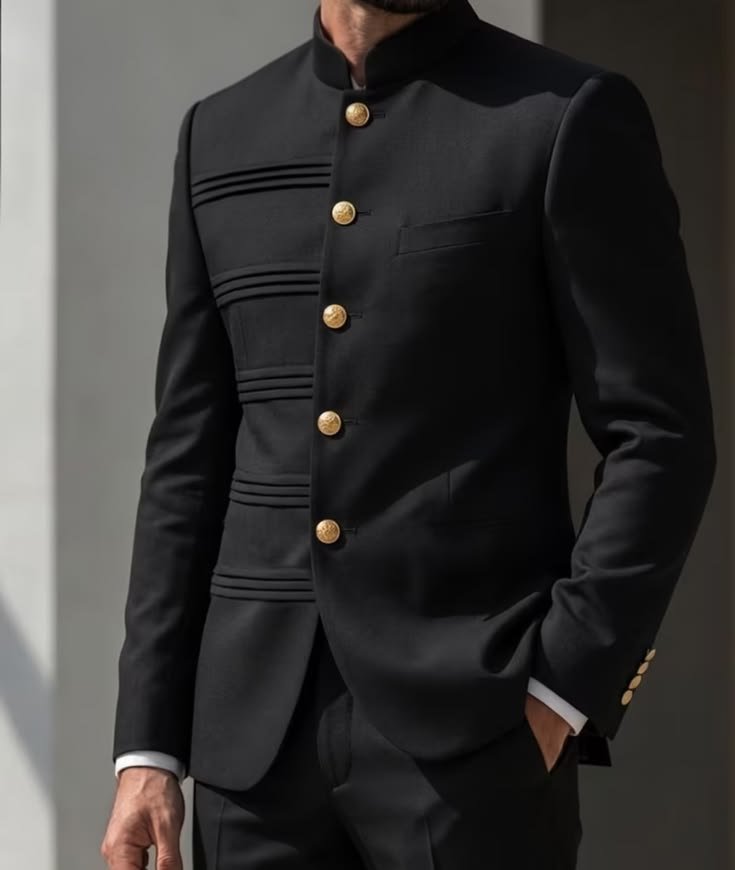
Walk into any room where Indian men are dressed for a serious occasion and you will know a Bandhgala when you see one. There is nothing else quite like it, the closed collar buttoned to the throat, the clean vertical button line, the structured silhouette that carries its own formality without requiring a tie, a lapel or any borrowed Western context to complete it. It simply stands on its own.
What most men do not know is what is happening inside that jacket to make it look and hold the way it does. A bandhgala jacket for men is one of the most technically demanding garments in Indian tailoring. Its defining feature the stand collar requires a precision of construction that a Western jacket’s open lapel does not. Its silhouette depends on an internal structure that is built by hand, layer by layer, before the outer fabric is ever touched. And the difference between a Bandhgala that looks composed from the first hour to the last and one that begins to lose its shape by the evening is almost entirely in how that internal construction was done.
This is an inside account of how a Bandhgala jacket is made the materials, the sequence, the hand-work, and the construction decisions that separate a jacket built to last from one that merely looks the part on the hanger.
Quick Answer: What Is a Bandhgala Jacket for Men?
A Bandhgala jacket for men is a structured formal jacket of Indian origin, defined by a high stand collar – bandh gala translates literally to “closed neck” that buttons completely to the throat, a vertical button placket from collar to hem, and a fitted, suppressed-waist silhouette. It is also known as a Jodhpuri jacket when paired with matching trousers as a complete suit. Unlike a Western jacket, it requires no tie, no dress shirt collar, and no lapel the collar and front placket together create a complete, self-contained formal identity. It is the most structurally demanding jacket in Indian tailoring and, when made correctly, one of the most enduring.
Where the Bandhgala Comes From: A Construction History
The Bandhgala’s origins sit at the precise intersection of two tailoring traditions. <cite index=”6-1″>It blends the structure of a Western suit jacket with the rich heritage of Indian attire</cite> an inheritance from the period when Indian royal courts absorbed British military tailoring conventions and transformed them into something entirely their own.
The result was a jacket that kept the structured chest and suppressed waist of British military dress but replaced the open lapel and collar with India’s own closed-neck tradition. The Jodhpur courts of Rajasthan are most frequently credited with its formal codification, hence the alternative name, Jodhpuri suit though similar closed-collar structured jackets existed across Mughal and Maratha court dress in earlier centuries.
What makes this history relevant to construction is that the Bandhgala has always been a jacket built for authority and ceremony not for casual adaptation or fast production. <cite index=”6-1″>Its defining feature, the bandh gala, gives the garment its clean lines and stately appearance</cite> and those clean lines depend entirely on the precision of what is built inside.
The Anatomy Of A Bandhgala: What Is Actually Inside
Before discussing the construction sequence, it helps to understand what a properly made Bandhgala jacket actually consists of because this is where most mass-produced and ready-to-wear versions cut corners, and where those corners become visible within the first season of wear.
The outer fabric is what you see – the wool, silk blend, velvet, or suiting fabric that gives the jacket its colour and surface character.
The canvas interlining is the structural foundation of the jacket, a layer of woven horsehair and cotton canvas stitched to the inside of the front panels that creates the chest shape, holds the button line upright, and gives the jacket its ability to mould to the body over time with wear. In a fused jacket, the construction method used in fast production this layer is replaced with a heat-bonded synthetic interfacing that is cheaper and faster but bubbles, delaminates, and loses its structure with dry cleaning and wear. A properly made Bandhgala uses full canvas or half canvas construction – never fused.
The collar interlining is specific to the Bandhgala and has no equivalent in Western jacket construction. The stand collar requires its own internal structure – a shaped, stiffened interlining that holds the collar upright, flush against the neck, and completely even in height around the entire circumference. This is the most technically demanding single component in the jacket, and the one that reveals the quality of construction most immediately when it fails.
The lining covers the internal construction and allows the jacket to slide on and off easily. In a bespoke Bandhgala, the lining is cut with ease allowances that move with the body rather than pulling against it.
The padding and shoulder construction shapes the shoulder line – the canvas roll, the shoulder pad if used, and the sleeve head wadding that fills the top of the sleeve and creates the smooth shoulder-to-sleeve transition visible from the outside.
The Construction Sequence: How A Bespoke Bandhgala Is Built
Stage 1: Measurement and Pattern Drafting
A bespoke Bandhgala begins not with fabric but with measurements and more measurements than a Western jacket requires, because the stand collar adds a critical dimension that an open lapel does not: the neck circumference, the collar height preference, the angle of the neck from the shoulder, and the precise point at which the collar meets the front button placket must all be calculated and drafted into the pattern before cutting.
The front button placket of a Bandhgala is a straight, unbroken vertical line from throat to hem. Any deviation in the cut any pull, any curve, any asymmetry is immediately visible because there is no lapel to soften or conceal it. The pattern must be drafted with a precision that leaves no margin for the kind of small errors that disappear in a Western jacket’s open front construction.
Stage 2: Fabric Cutting
Once the pattern is drafted and approved, the outer fabric is cut always on the correct grain, which determines how the jacket hangs and how the fabric drapes across the chest and back. Cutting off-grain is a shortcut that produces a jacket that twists, pulls, and gradually rotates at the hem with wear. In a Bandhgala, where the front placket must hang dead straight, off-grain cutting is immediately and permanently visible.
The canvas interlining is cut separately to its own pattern, shaped slightly differently from the outer fabric to account for the way canvas behaves during construction and the way it will shape over wear.
Stage 3: Canvas Pad-Stitching — The Heart of the Construction
This is the stage that separates a jacket that will last twenty years from one that will not survive five.
Pad-stitching is the process of hand-stitching the canvas interlining to the outer fabric in small, even stitches typically with a fine wool thread working across the entire chest panel in rows. Each stitch catches the canvas and the inner face of the outer fabric without coming through to the visible surface. The result, built up across hundreds of individual stitches, is a chest panel that is unified outer fabric and canvas moving together, moulding to the body over time as the jacket is worn.
In a fused jacket, this process is replaced by a heat-bonding machine that laminates the interfacing to the fabric in seconds. The result looks identical on the hanger. Under wear and cleaning, the difference becomes apparent: fused interlinings separate, bubble, and lose their shape; pad-stitched canvas moulds, softens and improves.
Stage 4: The Stand Collar – The Most Technically Demanding Component
The Bandhgala’s collar is where the jacket announces its quality or reveals its shortcuts.
The stand collar is constructed in multiple layers: the outer fabric cut on a precise curve that will allow the collar to stand upright and even around the full circumference of the neck; a shaped canvas or stiffened interlining inside the collar that maintains that upright structure; and an inner facing that finishes the inside of the collar cleanly.
The critical technical challenge is the collar curve. A collar cut too straight will pull away from the neck at the back. A collar cut with too much curve will buckle and collapse at the front. The correct curve is specific to each person’s neck – its circumference, the angle at which it meets the shoulder, the height at which the collar is worn. This is why a mass-produced Bandhgala, cut to a standard neck measurement, almost always shows some degree of collar instability standing away from the neck at the back, or dipping unevenly across the front and why a made-to-measure collar, drafted to the individual’s neck, sits flush and even from the first wear.
The collar is attached to the jacket body by hand stitched precisely at the exact point where the collar meets the front button placket on both sides, with the join completely invisible from the outside. This join is one of the most precise operations in the entire garment’s construction.
Stage 5: Setting the Sleeves
The sleeve of a Bandhgala is set into the armhole with a shaped sleeve head, a small roll of wadding at the top of the sleeve that fills the hollow between the shoulder and the sleeve cap and creates the smooth, rounded shoulder line visible from the outside.
The sleeve is set by hand in a bespoke jacket eased into the armhole in small sections, with the fullness distributed evenly so that no puckers or pulls appear at the shoulder. Machine-set sleeves in production jackets are faster but distribute ease less evenly, often producing a small pull at the front or back of the armhole that becomes more pronounced with wear.
Stage 6: Buttonholes and Buttons
The button placket of a Bandhgala runs from the throat to the hem in a single unbroken line typically five to seven buttons depending on the jacket’s length. In a properly made Bandhgala, these buttonholes are hand-worked cut and bound by hand in a technique that produces a buttonhole with more structural integrity and a cleaner finish than a machine-made equivalent.
The buttons themselves are chosen for weight, profile, and material appropriate to the fabric. Fabric-covered buttons in the same material as the jacket produce a seamless vertical line. Horn, resin or metal buttons add a deliberate contrast point. Either is correct – what matters is that the button weight does not pull the placket open or cause the jacket front to drag.
Stage 7: Final Pressing and Finishing
A bespoke Bandhgala is pressed throughout its construction at each stage, not only at the end using a tailor’s iron and pressing cloths to shape the canvas, set the collar, and define the silhouette as the jacket is built. This is called underpressing and it is as much a part of the construction as the stitching itself.
The final pressing shapes the jacket around a dress form or directly on the body steaming and moulding the canvas chest, the collar, and the shoulder line into the exact shape the jacket will hold through its lifetime of wear.
Fabrics That Work For A Bandhgala Jacket For Men
The Bandhgala’s structured construction works with a wider range of fabrics than a Western jacket because the collar and canvas provide structure independent of the fabric’s own body. That said, fabric choice significantly changes the occasion register and seasonal appropriateness of the jacket.
| Fabric | Best Season | Occasion Register | Character |
|---|---|---|---|
| Worsted wool | Winter, air-conditioned venues | Formal, professional | Clean surface, excellent shape retention |
| Silk blend | Winter ceremonies, receptions | High formal, festive | Natural lustre, rich drape |
| Velvet | Winter evenings, receptions | Statement formal | Deep texture, maximum visual presence |
| Tropical wool | Summer, transition seasons | Formal to semi-formal | Structure of wool with better breathability |
| Linen blend | Summer, outdoor occasions | Semi-formal | Relaxed texture, warm-climate appropriate |
| Brocade or jacquard | Festive, weddings | Ceremonial | Pattern and texture integrated into the fabric itself |
For guidance on fabric selection across different Indian seasonal conditions, our detailed comparison in best summer suit fabrics for India covers how these fabric families perform across Mumbai’s climate range. For a broader understanding of how fabrics combine across an Indian formal outfit, see our fabric pairing guide.
Bespoke vs Ready-To-Wear Bandhgala: What The Construction Difference Means In Practice
The difference between a bespoke and a ready-to-wear Bandhgala is not only visible – it is structural. The three areas where it manifests most clearly are:
The collar. A ready-to-wear collar is cut to a standard neck size. If your neck is slightly larger or smaller, or sits at a different angle than the standard, the collar will stand away from the neck at the back, dip unevenly across the front, or require constant adjustment through an event. A bespoke collar is drafted to your exact neck measurement and angle – it sits flush, even, and stable without any attention from the wearer.
The front placket. In a fused ready-to-wear jacket, the placket may appear flat on the hanger but develop a subtle ripple or pull after a few hours of wear as the fusing responds to body heat. In a canvassed bespoke jacket, the placket is supported by pad-stitched canvas that moves with the body rather than against it – it looks as composed at the end of the evening as at the beginning.
The fit through the chest and waist. The Bandhgala’s suppressed waist silhouette is one of its defining visual features. In a ready-to-wear garment, this suppression is cut to a standard proportion. In a bespoke garment, the waist suppression is calibrated to the individual enough to create the Bandhgala’s characteristic silhouette without creating the pulling and straining that comes from a suppression that is too aggressive for the wearer’s actual proportions.
At Shubham Shinde Atelier in Thane, every Bandhgala is built using full canvas construction – no fusing, no shortcuts. The collar is drafted fresh to each client’s neck measurement, the placket is cut on precise grain, and the waist suppression is calibrated in the first fitting rather than assumed from a standard size chart. It is the difference between a jacket that holds its form on a hanger and one that holds it on a person which is the only place it matters.
Browse our full suits collection and jackets range to see the made-to-measure Bandhgala options available at Shubham Shinde Atelier.
The Bandhgala in the Context of Indian Formal Dressing
The Bandhgala sits at a specific and irreplaceable position in Indian men’s formal dressing and understanding that position helps clarify when it is the right jacket and when another garment serves the occasion better.
It is more formal than a Western suit for Indian occasions because it carries its Indian identity explicitly rather than as an adaptation. It is less elaborate than a sherwani, which makes it appropriate for occasions where a sherwani’s ornamentation would be excessive. It works as a standalone garment unlike a suit, which requires a specific shirt, tie, and collar combination to read as complete.
For a man attending a formal Indian event – a reception, a high-ceremony dinner, a significant family occasion – a well-made Bandhgala in the right fabric for the season is the most considered choice available. It does not imitate. It does not borrow from another tradition. It simply is what it is: India’s most structured jacket, made for exactly these moments.
For the history, cultural context, and styling guide, read our dedicated post: the Bandhgala — India’s definitive expression of structured elegance. For a comparison of the Bandhgala within the broader Indian formal wardrobe, our guide on suits every man should own covers where it sits relative to Western suit styles.
Frequently Asked Questions
What is the difference between a Bandhgala and a Nehru jacket? The Nehru jacket is typically shorter, less structured, and worn as an informal or semi-formal garment – often over a kurta or casual shirt. The Bandhgala is a fully structured formal jacket with a canvassed chest construction, a more fitted silhouette, and a formality register equivalent to a Western dress suit. The collar height and construction are also typically different, the Bandhgala’s stand collar is more precisely structured and higher than the Nehru jacket’s softer, shorter collar.
What is the difference between a Bandhgala and a Jodhpuri suit? They are the same jacket by different names. Bandhgala refers to the jacket specifically – the closed-neck style. Jodhpuri suit refers to the complete ensemble of the Bandhgala jacket paired with matching trousers, named after the Jodhpur courts where this pairing was formalised. When the jacket is worn with contrasting trousers, it is typically referred to as a Bandhgala jacket rather than a Jodhpuri suit.
What fabric is best for a Bandhgala jacket for men? For winter and formal evening occasions: silk blend or worsted wool. For summer and outdoor events: tropical wool or a fine linen blend. For statement occasions and receptions: velvet or brocade. The right fabric depends on the season, the time of day, and the formality level of the occasion. See our summer suit fabrics guide for a full seasonal breakdown.
How long does a bespoke Bandhgala take to make? At Shubham Shinde Atelier, a fully bespoke Bandhgala requires a minimum of 4 to 6 weeks from the first measurement appointment to the final fitting allowing for pattern drafting, canvas construction, two to three intermediate fittings, and final pressing and finishing. For events with a fixed date, we recommend beginning the process at least 8 weeks in advance.
Can a Bandhgala be worn to a modern reception or contemporary event? Yes and increasingly, it is the jacket of choice for exactly these occasions. A Bandhgala in a contemporary fabric midnight navy worsted wool, deep charcoal, or a subtle textured silk blend reads as distinctly modern while carrying the cultural grounding that a Western suit cannot provide at an Indian occasion. The formality is inherent; the contemporary expression comes from fabric and colour choice.
How is a Bandhgala different from a regular suit jacket in terms of construction? The primary construction difference is the collar. A Western jacket’s open lapel is structurally simpler than a Bandhgala’s stand collar – the lapel rolls naturally and does not require the precise shaping and stiffening that a stand collar demands. The Bandhgala’s collar construction adds a significant layer of technical complexity to the garment. Additionally, the straight front placket of a Bandhgala requires more precise canvas construction than the open-front construction of a Western jacket, where small imperfections are concealed by the lapel’s overlap.
The Jacket That Does Not Borrow
Every other formal jacket an Indian man might wear for a significant occasion is, in some sense, an adaptation – a Western suit adjusted for the occasion, or a sherwani’s ornamentation dialled up or down depending on the event. The Bandhgala borrows from no tradition but its own. It stands on its own construction, its own history, and its own formal identity.
Making one correctly with pad-stitched canvas, a collar drafted to the individual neck, a placket that hangs dead straight, and a silhouette built to hold its shape across years of wear is among the most technically demanding work in Indian tailoring. It is also among the most rewarding: a jacket that, when it fits correctly and is made from the right fabric, requires no explanation, no accessory, and no context to make its point.
For a consultation on a made-to-measure Bandhgala at Shubham Shinde Atelier, visit our jackets collection, browse the full suits range, or get in touch directly. Learn more about our bespoke approach on the About Us page.
